
Starting a minicab business can mean anything from operating one private hire vehicle from home to building a local fleet with dozens of drivers.
The basic idea is simple: customers pre-book journeys and your business arranges for licensed drivers and vehicles to complete them.
But legally, a minicab business is not simply somebody with a car and a telephone.
In England and Wales, minicabs fall within the private hire vehicle system. Private hire journeys must be booked in advance, and if you want to accept those bookings yourself you will generally need the appropriate private hire operator licence.
Drivers and vehicles also need to be correctly licensed.
That means there are really three separate parts to the operation:
The operator accepts the booking.
The licensed driver carries the passenger.
The licensed private hire vehicle is used for the journey.
This guide explains how to put those pieces together and build a minicab business that can grow from one vehicle into a larger local private hire operation.
If you need the licensing process in more detail, also read:
How to Become a Private Hire Driver in the UK
How to Become a Private Hire Operator in the UK
How to Start a Taxi or Private Hire Business in the UK
What is a minicab business?
In everyday language, a minicab business is usually a private hire company.
Customers contact the operator and book a vehicle in advance.
Bookings might arrive through:
- telephone
- website
- app
- booking form
- business account
- hotel or venue
The operator then arranges for an appropriately licensed vehicle and driver to complete the journey.
Unlike a licensed taxi or Hackney carriage, a private hire vehicle cannot simply pick up somebody who waves it down in the street.
It must be pre-booked.
That distinction is fundamental to the minicab business model.
Is a minicab the same as a taxi?
Passengers often use the words interchangeably, but the legal distinction matters.
A licensed taxi or Hackney carriage can generally accept immediate hires from authorised ranks and street hails within the rules applying to its licence.
A private hire vehicle or minicab normally works through advance bookings accepted by a licensed operator.
If you specifically want to operate Hackney carriages, see our How to Become a Taxi Driver and Hackney Carriage Driver guide.
This article focuses on the private hire or minicab model.
Step 1: Decide what kind of minicab company you want
Not every private hire business needs to operate in the same way.
You could focus on:
- short local journeys
- station transfers
- airport transfers
- school transport
- hospital journeys
- business accounts
- executive travel
- events
- long-distance work
- group transport
- a mixture of services
Your target market affects the vehicles, prices, drivers and technology you need.
For example, a local minicab company might complete hundreds of short journeys each week.
An airport-transfer operator might complete far fewer bookings but at much higher average values.
Decide which work you want before investing heavily.
Step 2: Identify the correct licensing authority
In England and Wales, private hire licensing is normally handled by the local council.
London is different and is licensed by Transport for London.
The rules can vary significantly between licensing authorities.
Before applying, check:
- operator licence requirements
- driver licence requirements
- vehicle requirements
- application fees
- operating-base rules
- planning requirements
- criminal-record checks
- vehicle age limits
- emissions requirements
- signage
- record keeping
- complaints procedures
Do not assume another minicab firm is following the same conditions as you.
They may be licensed somewhere else.
Step 3: Apply for the private hire operator licence
If you intend to accept private hire bookings in England or Wales, you will generally need an operator licence.
GOV.UK states that you can be prosecuted if you receive payment for taking private hire bookings or supply drivers for hire without the required operator licence.
Operator licences can last for up to five years.
Outside London, apply through the local council where your private hire business will operate.
In London, apply through Transport for London.
Your licensing authority may investigate whether you are a fit and proper person to operate a private hire business.
The application can also involve conditions covering premises, booking records, staff and complaints.
Do not begin taking bookings simply because you have submitted the application.
Wait until the required licence has actually been granted.
Step 4: Understand the London rules if you operate in the capital
London private hire is regulated by Transport for London.
TfL licences:
- private hire drivers
- private hire vehicles
- private hire operators
London operators must meet specific rules covering issues including operating centres, booking records and the way journeys are accepted and managed.
TfL also uses a tiered operator licence fee structure based on the expected number of vehicles.
For an operator expecting to use up to 10 vehicles, the current five-year operator fee totals £2,000.
Larger operations pay considerably more.
Anyone planning a London minicab business should therefore check current TfL requirements and fees before building the rest of the operation.
Step 5: Scotland works differently
Scotland does not simply use the same operator-licensing model as England and Wales.
Scottish guidance covers taxi and private hire car licensing and also a separate booking-office licensing regime.
A booking-office licence is required for premises used for taking bookings for four or more relevant taxis or private hire cars.
Because Scottish rules differ, check with the local licensing authority before setting up the booking operation.
Do not take an English minicab guide and assume every detail applies unchanged in Scotland.
Step 6: Northern Ireland has its own operator system
Northern Ireland also operates differently.
Taxi operator licences are handled through the Driver & Vehicle Agency.
There are currently two main operator categories:
Small operator
A maximum of two taxi vehicles available for use at any one time.
Large operator
No restriction on the number of taxi vehicles available for use at any one time.
The current application fee is £140, with additional grant-of-licence costs depending on the licence type, duration and number of vehicles.
Northern Ireland applicants should use the current DVA and nidirect guidance rather than following the England and Wales process.
Step 7: Make sure the driver is correctly licensed
If you plan to drive passengers yourself, you need the appropriate private hire driver licence.
In England and Wales, applicants normally need to satisfy requirements covering matters such as:
- right to work
- driving licence
- suitability
- criminal-record checks
- medical fitness
- local assessments
The exact requirements vary between licensing authorities.
A driver licence alone does not allow you to independently take private hire bookings.
That is the distinction between being a private hire driver and being a private hire operator.
Step 8: License the vehicle
Every private hire vehicle needs the appropriate vehicle licence.
In England and Wales, GOV.UK states that vehicles used as taxis or PHVs need to be licensed.
For the standard taxi and private hire licensing system, the vehicle must have no more than eight passenger seats.
Licensing authorities can impose conditions covering matters such as:
- age
- emissions
- appearance
- licence plates
- signage
- safety
- vehicle testing
- passenger capacity
Check before buying.
One of the most expensive mistakes a new minicab operator can make is buying a car and discovering afterwards that the council will not license it.
Step 9: Arrange suitable private hire insurance
Ordinary personal motor insurance is not sufficient for paid private hire work.
Your vehicle needs insurance appropriate for carrying passengers for hire and reward.
Tell the insurer exactly how the vehicle will be used.
The premium can depend on:
- location
- driver age
- driving history
- claims
- vehicle
- mileage
- number of drivers
- type of work
Get an insurance quote before purchasing an expensive vehicle.
A car that looks financially attractive may turn out to be costly to insure for private hire.
Step 10: Decide whether you need premises
A traditional minicab business might operate from a high-street office or taxi base.
But modern operators can potentially operate very differently.
Depending on licensing, planning and other relevant requirements, a smaller business may be able to operate from home.
Do not rent commercial premises simply because older minicab companies have them.
Equally, do not assume a home address is automatically acceptable.
Check:
- operator-licence conditions
- planning position
- tenancy or mortgage conditions
- customer access
- staff requirements
- insurance
London operators should pay particular attention to TfL operating-centre rules.
Step 11: Choose your business structure
A minicab company can potentially operate as:
- sole trader
- partnership
- limited company
The best structure depends on the business.
A small owner-driver operation may prefer the simplicity of trading as a sole trader.
A larger fleet may choose a limited company.
Your structure affects areas including:
- tax
- accounting
- ownership
- business administration
- responsibilities
It should also be aligned with the legal entity holding the operator licence.
Take accounting advice if necessary.
Step 12: Choose a business name
Your minicab company name may eventually appear on:
- website
- booking confirmations
- vehicles
- invoices
- customer reviews
- social media
- emails
Choose something easy to remember and spell.
Before committing, check:
- Companies House
- available domain names
- social media
- similar local firms
- trade marks where appropriate
Do not choose a name that could mislead passengers into thinking you are another established operator.
Step 13: Work out your minicab fares
Pricing needs to cover the actual cost of providing the service.
Possible pricing models include:
- minimum fare
- price per mile
- mileage tiers
- zones
- fixed journeys
- airport rates
- waiting charges
- night rates
- vehicle-specific prices
Private hire operators in England have much more freedom over fares than regulated Hackney carriage tariffs.
But freedom does not mean prices should be guessed.
Calculate:
- vehicle costs
- insurance
- fuel or electricity
- driver payment
- empty mileage
- waiting
- booking technology
- operator costs
- payment fees
- profit margin
Our How to Set Taxi and Private Hire Fares guide explains how to build the pricing structure properly.
Step 14: Set a minimum fare
Minimum fares can be particularly important for local minicab companies.
A short journey still involves:
- travelling to the customer
- waiting
- loading passengers
- driver time
- vehicle costs
- administration
A pure mileage calculation can make very short jobs uneconomic.
Work out the lowest fare that makes sense for your operation.
Do not simply copy the cheapest competitor.
Step 15: Create zones if they suit your market
Local private hire businesses often operate within predictable geographic areas.
Zones can make pricing and dispatch easier.
You might have:
- town-centre zone
- surrounding suburbs
- airport zone
- neighbouring town
Different rules can then apply between zones.
For some operations, this is easier than calculating every local journey purely by mileage.
Test the system using real journeys before making it live.
Step 16: Decide how drivers will be paid
Once you use other drivers, you need a clear commercial arrangement.
Possible models include:
- fixed payment per job
- percentage of fare
- driver keeps fare and pays commission
- vehicle rental
- employment arrangements
Employment status and tax depend on the real working relationship.
Simply calling somebody self-employed does not necessarily make that the correct legal or tax position.
Take professional advice if you are uncertain.
Whatever arrangement you use should be built into your pricing.
A fare that works when you drive the journey yourself may not work when another driver receives a substantial share.
Step 17: Create a proper booking process
You need a consistent process for every customer.
A booking should capture enough information to fulfil the journey safely and accurately.
That can include:
- passenger name
- telephone number
- pickup
- destination
- date
- time
- fare
- driver
- vehicle
- payment status
- relevant instructions
Airport journeys may also need:
- flight number
- terminal
- luggage
- meet-and-greet information
Do not leave confirmed jobs scattered across WhatsApp, SMS, email and pieces of paper.
Step 18: Understand booking-record requirements
Private hire operators are required to keep records.
The exact detail can depend on the licensing authority.
Department for Transport statutory standards recommend recording information including:
- passenger
- booking time
- pickup
- destination
- driver
- driver licence number
- vehicle registration
- booking staff
- dispatch staff
Local conditions may require more.
Before opening, confirm exactly what information your authority expects you to keep and how long it needs to be retained.
Our Taxi Operator Checklist covers this in more detail.
Step 19: Choose your booking and dispatch system
A one-car business can initially be simple.
But once several drivers and advance bookings are involved, dispatch becomes one of the core parts of the company.
Your system needs to show:
- upcoming bookings
- unallocated work
- allocated driver
- vehicle
- price
- customer
- booking changes
- payment status
DM Taxi Assistant is designed for taxi, minicab, private hire, chauffeur and airport-transfer operators.
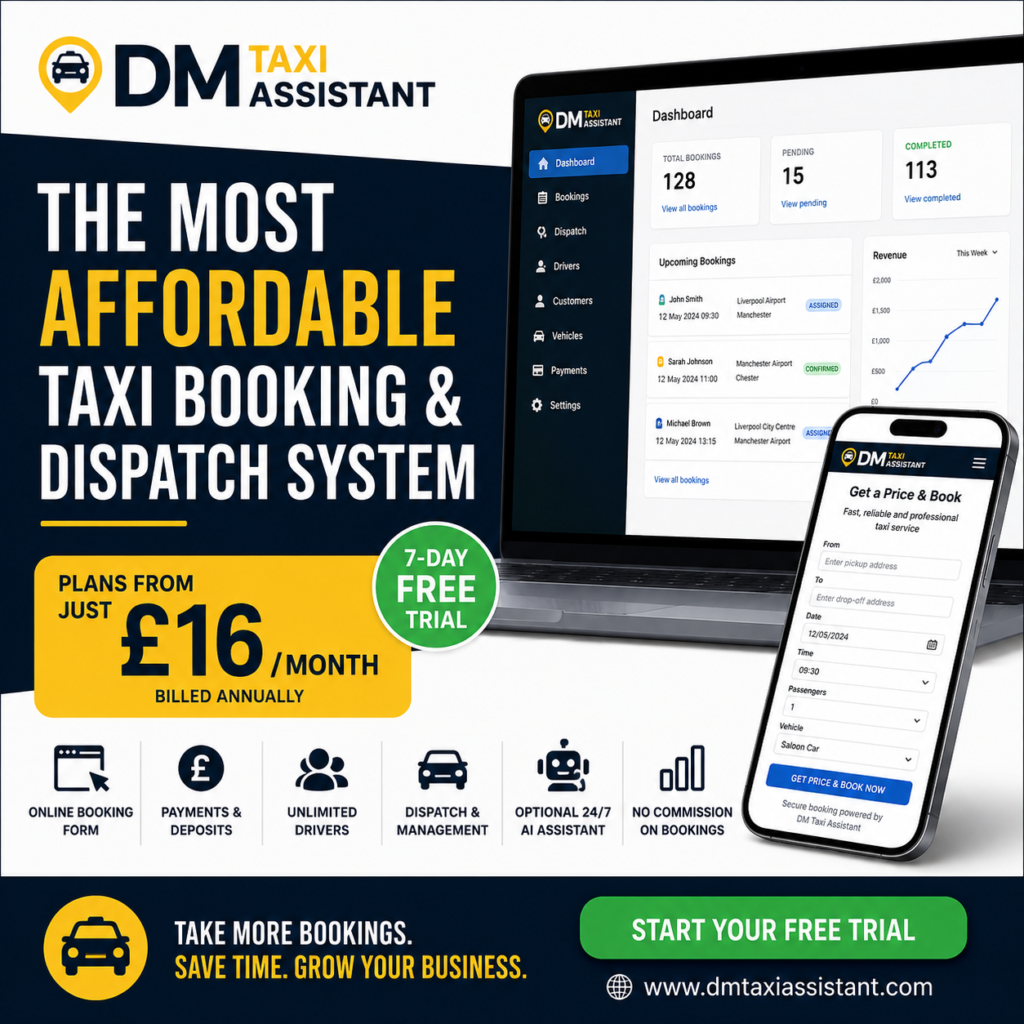
It can provide:
- online quotations using your own tariff
- booking form
- customer details
- return journeys
- payments and deposits
- enquiries
- booking dashboard
- driver allocation
- dispatch
- optional AI customer assistant
The operator controls the fares and business rules.
Software does not replace your operator licence or your responsibility for legally compliant booking records.
Step 20: Make online booking available
Modern passengers increasingly expect to be able to do more than telephone a minicab office.
An online booking process lets customers potentially:
- enter journey
- choose vehicle
- obtain price
- select date and time
- provide passenger details
- book return
- pay
This can be particularly useful when the operator is driving or when customers want to book outside normal office hours.
Read our How to Take Taxi and Private Hire Bookings Online guide for the full setup.
Step 21: Build a website
A good website can help your minicab business attract direct customers rather than depending entirely on other platforms.
It should make clear:
- where you operate
- services
- vehicle types
- telephone number
- booking process
- airport services
- contact information
Create useful pages around the areas and journeys your customers actually search for.
For example:
- minicab in your town
- airport transfer from your town
- local station transfers
- group transport
- executive private hire
Our How to Build a Taxi Website That Gets Bookings guide explains the process.
If you do not already have a website, DM Site Builder provides a free website option for taxi and private hire businesses.

Step 22: Build your Google presence
Local minicab companies depend heavily on nearby customers.
A properly configured Google Business Profile can help eligible businesses appear when people search for local transport.
Keep information accurate.
Use your genuine business name and service areas.
Add real photographs.
Encourage genuine reviews.
Do not create fake locations or pretend to have offices in towns where you do not genuinely operate.
Step 23: Start collecting reviews
Passenger trust is extremely important.
Ask satisfied direct customers for honest reviews.
Make it easy by sending your direct review link after a successful journey.
Never buy reviews or create fake customer accounts.
A strong genuine reputation can become one of your biggest advantages over a new competitor.
Step 24: Target business accounts
Local businesses can provide regular minicab work.
Potential customers include:
- hotels
- offices
- factories
- recruitment agencies
- care businesses
- universities
- restaurants
- venues
- travel companies
They may need:
- staff transport
- visitor transport
- airport transfers
- account journeys
- monthly invoicing
A handful of strong business accounts can produce significant recurring work.
Step 25: Build airport work
Airport bookings can increase the average value of your jobs.
Passengers often book well in advance and may require both outbound and return journeys.
Make sure your operation can manage:
- flight numbers
- luggage
- airport charges
- parking
- delays
- meet and greet
- return bookings
See our How to Start an Airport Transfer Business guide if airport work is a major part of your plan.
Step 26: Create a backup-driver network
If you accept a confirmed booking, the customer expects somebody to arrive.
Create backup arrangements before you need them.
A driver can become ill.
A vehicle can break down.
Traffic can delay a previous journey.
Build relationships with other appropriately licensed drivers and operators so you have options when your own fleet cannot cover a job.
Step 27: Keep track of documents and expiry dates
As the number of drivers increases, paperwork can become a serious management problem.
Track:
- driver licence expiry
- vehicle licence expiry
- insurance
- MOT
- other relevant documents
Create reminders before the expiry date.
Never wait for a driver to tell you their licence expired yesterday.
Step 28: Create a complaints procedure
Complaints are inevitable in passenger transport.
You may face issues such as:
- late driver
- missed pickup
- customer conduct
- fare dispute
- driver conduct
- lost property
- vehicle condition
Your licensing authority may impose specific complaint requirements.
Have a process covering who records the complaint, who investigates it and what information is retained.
Serious safeguarding or criminal matters may also need to be reported to the appropriate authority.
Step 29: Protect passenger information
A minicab operator handles a considerable amount of personal data.
That can include:
- names
- telephone numbers
- addresses
- destinations
- travel times
- payment information
Create appropriate privacy information and check whether the business needs to pay the Information Commissioner’s Office data-protection fee.
Limit access to passenger information to people who genuinely need it.
Step 30: Keep proper accounts
Record business income and expenses from the first day.
That includes:
- fares
- cash
- cards
- deposits
- driver payments
- fuel
- insurance
- vehicle costs
- licences
- software
- marketing
- office costs
Do not treat the total passenger fares collected as personal income without understanding the business accounts.
A growing minicab operation can process substantial amounts of money even when actual profit margins are relatively modest.
Step 31: Watch VAT turnover
The current UK VAT registration threshold is £90,000 of taxable turnover.
You must generally register if taxable turnover over the previous 12 months goes above the threshold, or if you expect to exceed it within the next 30 days under HMRC’s rules.
You can also register voluntarily below the threshold.
A growing minicab business can reach the threshold faster than a single driver expects, especially once several drivers are completing journeys through the operation.
Take accounting advice before the threshold becomes urgent.
Step 32: Start with enough drivers to cover the work — not impress people
Do not recruit 50 drivers because you want to call yourself a large operator.
Drivers need work.
If the circuit is quiet, they will leave.
Start by building demand.
Then add capacity as booking volume grows.
A useful growth pattern can be:
Owner-driver
↓
Regular direct bookings
↓
Backup driver
↓
Several active drivers
↓
Local fleet
↓
Dispatch staff and more automation when volume justifies it
Scale because customers need more vehicles, not because the number of drivers looks good on your website.
Step 33: Measure the business properly
Track more than total bookings.
Look at:
- jobs per day
- average fare
- driver supply
- missed bookings
- customer cancellations
- dead mileage
- airport jobs
- repeat customers
- direct customers
- business-account work
- booking source
You may discover that 100 poor-value bookings are less profitable than 50 better jobs.
Volume alone does not make a successful minicab company.
How much does it cost to start a minicab business?
There is no single UK figure.
Costs can include:
- operator licence
- driver licence
- vehicle licence
- DBS
- medical
- training
- vehicle
- finance
- insurance
- booking system
- website
- telephone
- premises
- accounting
- working capital
A one-car home-based operation can be significantly cheaper than a traditional staffed office with multiple vehicles.
Our full How Much Does It Cost to Start a Taxi or Private Hire Business? guide breaks the costs down individually.
Can you start a minicab business with one car?
Yes.
A private hire operator does not need a huge fleet to begin.
Starting with one car can allow you to learn:
- which journeys make money
- where customers come from
- how long bookings really take
- what prices work
- what customers expect
- when additional drivers are genuinely needed
There is no advantage in creating unnecessary fixed costs before demand exists.
Can a minicab business operate from home?
Potentially, depending on the rules affecting your operation.
Check:
- operator licensing conditions
- planning
- tenancy or mortgage restrictions
- staff
- customer visits
- insurance
Do not assume the answer is automatically yes or no.
Your licensing authority should be one of the first places you check.
Does a minicab company need its own app?
Not necessarily.
Large local operators may benefit from passenger and driver apps.
But a smaller operation can potentially provide an excellent online booking experience through a mobile-friendly website without asking passengers to install anything.
Choose technology based on how your customers actually book.
Do not buy an app simply because large competitors have one.
Should you compete with Uber on price?
Not automatically.
Your direct private hire business can compete on:
- advance booking
- known local operator
- fixed pricing
- reliable airport journeys
- vehicle choice
- communication
- business accounts
- repeat-driver relationships
Trying to become cheaper than every ride-hailing fare can produce a busy business with poor margins.
Understand your costs first.
Minicab business startup checklist
Before taking bookings:
- Identify the licensing authority
- Obtain operator licence where required
- Obtain correct driver licence
- License each vehicle
- Arrange hire-and-reward insurance
- Read licence conditions
- Choose business structure
- Choose business name
- Decide services
- Create pricing
- Set minimum fares
- Configure zones or fixed fares if needed
- Create booking terms
- Set payment options
- Put booking records in place
- Set up booking and dispatch system
- Create website
- Test online booking
- Create privacy notice
- Check ICO obligations
- Set up bookkeeping
- Monitor VAT turnover
- Verify driver documentation
- Verify vehicle documentation
- Create expiry reminders
- Create backup-driver plan
- Create complaints procedure
- Start building direct customers
- Ask for genuine reviews
- Add drivers as real demand increases
What should you read next?
The most useful related DM News guides are:
How to Become a Private Hire Operator in the UK
Taxi Operator Checklist: Everything You Need Before Taking Bookings
How Much Does It Cost to Start a Taxi or Private Hire Business?
How to Get More Taxi and Private Hire Bookings
How to Take Taxi and Private Hire Bookings Online
If you need the website, DM Site Builder provides a free website option for taxi and private hire businesses.
For the operational side, DM Taxi Assistant can provide online pricing, customer bookings, payments, enquiries and driver dispatch.
A successful minicab business does not need to begin with 100 cars.
Get the licensing right, make the booking process reliable, build enough demand for the vehicles you already have and expand the fleet when customers give you a reason to.
Thanks for visiting DM News! If you’ve got a question, a story tip, or anything you’d like to share, head over to DriverMatty.com — I love to hear from you. While you’re there, don’t forget to check out my other websites and social media channels.
Sources
Operator Licences for Private Hire Vehicles — GOV.UK
Driver Licences for Taxis and Private Hire Vehicles — GOV.UK
Vehicle Licences for Taxis or Private Hire Vehicles — GOV.UK
Taxi and Private Hire Vehicle Licence Eligibility — GOV.UK
Statutory Taxi and Private Hire Vehicle Standards — Department for Transport
Private Hire Operator Licence — Transport for London
Taxi and Private Hire Car Licensing: Booking Offices — Scottish Government
Apply for a Taxi Operator Licence — nidirect




