
Getting licensed is only the beginning.
Once you have a taxi, private hire, chauffeur or airport-transfer business, the next challenge is getting enough profitable bookings to keep the vehicle moving.
Many operators start by relying on Uber, another booking app, a local circuit or word of mouth. Those can all provide work, but if you want to build a business with real long-term value, you also need customers who find and book your company directly.
That means building your own presence on Google, collecting genuine reviews, creating a useful website, making it easy to obtain a price and book, responding quickly to enquiries and giving existing passengers a reason to use you again.
This guide explains practical ways taxi and private hire businesses can generate more bookings without relying entirely on third-party apps.
If you are still setting the business up, start with our guides:
How to Become a Private Hire Driver in the UK
How to Become a Private Hire Operator in the UK
How to Start a Taxi or Private Hire Business in the UK
Why direct taxi bookings matter
Imagine two drivers earning exactly the same amount this week.
Driver one receives almost every journey from a third-party platform.
Driver two receives half their work from an app and half directly from customers who found their own business.
The second driver is gradually building something more valuable.
They are building:
- a recognisable business name
- Google visibility
- genuine customer reviews
- repeat passengers
- business accounts
- website traffic
- their own booking history
- direct referrals
Third-party platforms can still be useful.
The aim does not have to be to stop using them overnight.
The aim is to gradually reduce how dependent your business is on somebody else supplying every passenger.
Step 1: Get your Google Business Profile right
For many taxi and private hire businesses, Google can be one of the most important sources of direct customers.
Someone searching for:
taxi near me
airport taxi
private hire near me
8 seater taxi
or:
airport transfers Liverpool
may be ready to book immediately.
A properly set up Google Business Profile can help customers find your business in Google Search and Google Maps.
Google says local search results are mainly influenced by:
- relevance
- distance
- prominence
You cannot simply pay Google to place your business at the top of the normal local results.
Complete your profile properly
Make sure your profile has accurate:
- business name
- primary category
- additional relevant categories
- telephone number
- website
- opening hours
- service information
- photographs
- service areas
Do not add keywords to your business name unless they are genuinely part of your real business name.
For example, if your genuine company is called:
Smith Travel
do not change your Google name to:
Smith Travel Manchester Airport Taxi Cheap Minibus Liverpool
just because you want those keywords.
Google requires businesses to represent their genuine real-world name.
What if you work from home?
Many taxi and private hire businesses operate from a home address but customers do not visit the property.
Google supports service-area businesses.
If customers do not visit your address, you should normally hide the address from the public-facing profile and specify the areas that you actually serve.
Do not claim a virtual office simply to obtain another Google listing.
Use genuine business information.
Don’t claim the whole UK just because you drive nationwide
Airport-transfer businesses often travel across the country.
That does not necessarily mean your Google Business Profile should claim that the whole UK is your local service area.
Concentrate primarily on the area where customers actually originate and where your business is genuinely based.
Your website can target longer-distance journeys separately.
Step 2: Get more genuine Google reviews
Reviews are one of the most valuable assets a local taxi company can build.
They give a potential customer evidence that other passengers have already trusted the business.
Google also states that review count and positive ratings can contribute to local prominence.
Do not wait for customers to randomly leave reviews.
Ask them.
After a successful journey, send something simple such as:
Thanks for travelling with us today. If you were happy with the service, we’d really appreciate an honest Google review.
Then send the customer your direct Google review link.
Google allows businesses to create a direct review link and QR code.
You could add that link to:
- booking-completion emails
- thank-you messages
- receipts
- business cards
Never buy Google reviews
Do not buy reviews.
Do not create fake passenger accounts.
Do not offer a discount or free journey in return for a positive review.
Google prohibits fake and incentivised reviews and can remove reviews or place restrictions on a Business Profile.
You should also avoid only asking customers you know will give five stars while deliberately filtering everyone else out.
Ask genuine customers for genuine feedback.
Step 3: Build a website that is designed to generate bookings
A taxi website should not simply be an online business card.
Its main job should be to turn visitors into enquiries and bookings.
Within seconds, a potential passenger should be able to understand:
- what you do
- where you operate
- what vehicles you offer
- whether you cover their journey
- how to obtain a price
- how to book
- how to contact you
Do not make customers hunt around the website trying to find the booking button.
Put a clear booking or quotation call to action high on the page.
Your website should work properly on a phone
A large proportion of taxi customers will find you while using a mobile phone.
Make sure:
- text is easy to read
- buttons are easy to press
- telephone numbers work
- booking forms are simple
- pages load quickly
- customers do not need to zoom
- important information is not hidden
Starting without a website?
If you do not have one yet, DM Site Builder lets businesses create a professional mobile-ready website for free.
It can be used for taxi, private hire, chauffeur, airport-transfer and other small businesses.
That removes one of the biggest excuses new operators have for relying completely on social media or third-party apps.
Get the basic website live, then improve it as the business grows.

Step 4: Create pages for the journeys people actually search for
This is where taxi SEO becomes particularly useful.
Do not create one homepage and expect it to rank for every service and every destination.
Think about what customers actually type into Google.
For an airport-transfer business that might include:
- Liverpool to Manchester Airport taxi
- Chester to Manchester Airport transfer
- Manchester Airport to Liverpool taxi
- Liverpool to Heathrow transfer
- 8 seater Manchester Airport transfer
- executive airport transfer Liverpool
For a local private hire company it may include:
- taxi in Warrington
- private hire St Helens
- taxi to Liverpool Airport
- wheelchair taxi near me
- minibus taxi Warrington
Create useful pages around the work you genuinely provide.
Do not create hundreds of rubbish location pages
There is a big difference between a useful route page and copying the same page 500 times while changing one town name.
A good route page might explain:
- approximate journey distance
- typical travel time
- airports or terminals served
- available vehicle types
- luggage considerations
- pickup arrangements
- how pricing works
- booking information
- frequently asked questions
Write for the passenger first.
Google’s own SEO guidance recommends useful, original, people-first content rather than pages made primarily to manipulate rankings.
Step 5: Make obtaining a price easy
A surprising number of taxi websites make the customer work far too hard.
The passenger wants to know:
Can you do the journey?
How much is it?
Can I book it?
If getting those answers requires three phone calls and waiting two hours for a WhatsApp reply, there is a good chance some customers will continue searching.
You can provide prices through:
- instant online quotation
- booking form
- telephone
- live chat
- messaging
- manual enquiry
Not every journey needs to be automatically priced.
Unusual jobs can still become enquiries.
But straightforward work should be as easy as possible for the passenger.
Step 6: Stop losing enquiries while you are driving or asleep
This is a particular problem in the taxi industry.
The operator is often also the driver.
You might be:
- driving
- helping a passenger
- sleeping
- at the airport
- loading luggage
- on another telephone call
Meanwhile a new customer is asking:
How much to Manchester Airport tomorrow morning?
If nobody answers, the passenger can simply continue looking.
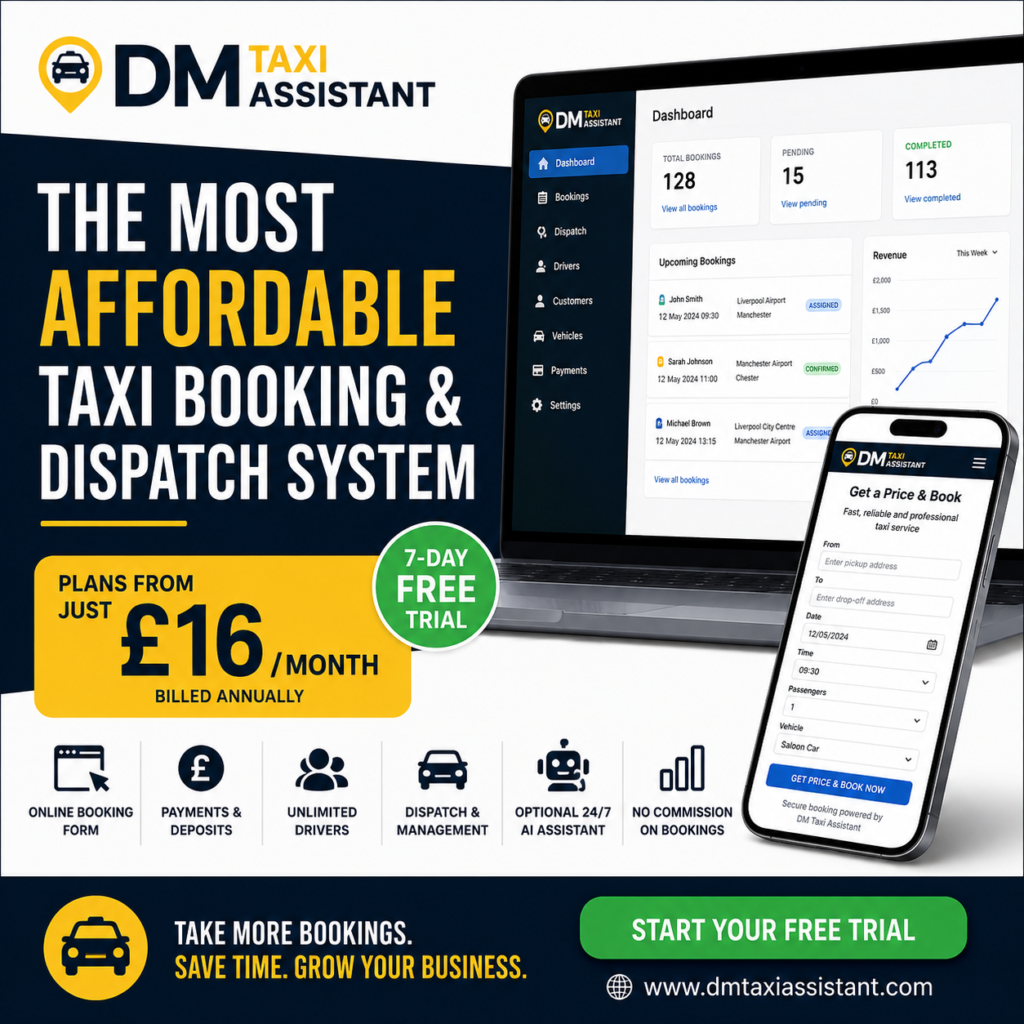
This is one of the reasons DM Taxi Assistant was created.
DM Taxi Assistant is designed specifically for taxi, private hire, chauffeur and airport-transfer businesses.
It can provide:
- an AI customer assistant
- online quotations using your own pricing
- a booking form
- booking confirmations
- deposits and online payments
- enquiries for jobs it cannot automatically answer
- booking management
- driver allocation
- driver dispatch
- an operator portal
The AI assistant works from information and prices configured by the operator.
If it does not know something, it can take an enquiry instead of inventing an answer.
That means a customer can potentially ask a question, get a price and book while the operator is doing another job.
DM Taxi Assistant currently offers a 7-day free trial and can also provide a hosted booking page if you do not yet have a website.
If you do have a website, the booking form and assistant can be added to it.
The aim is straightforward:
stop making customers wait for somebody to manually answer every routine enquiry.
Step 7: Reduce booking friction
Every unnecessary step between the customer and the booking gives them another opportunity to leave.
Imagine this:
Customer finds your website.
↓
Customer fills out a quote form.
↓
You receive an email.
↓
You reply two hours later.
↓
Customer asks whether an estate car is available.
↓
You reply again.
↓
Customer asks how to pay.
↓
You send bank details.
↓
Customer disappears.
Now compare it with:
Customer enters journey.
↓
Customer sees available options.
↓
Customer receives a price.
↓
Customer books.
↓
Customer pays the required deposit.
↓
Booking appears in your system.
The easier route will generally be better for both customer and operator.
Look at your own booking journey as though you have never seen your business before.
Step 8: Make your prices easy to understand
Customers do not necessarily need your entire fare structure published online.
But they should understand what is included when they receive a quote.
Be clear about:
- airport charges
- parking
- meet and greet
- waiting
- additional stops
- larger vehicles
- night rates
- child-seat arrangements
- payment
- deposits
Unexpected extras damage trust.
For airport-transfer businesses in particular, a simple fixed-price quote can be easier for passengers to understand than an unclear meter-style estimate.
Your pricing still needs to be profitable.
Do not reduce prices simply because another company appears cheaper.
Step 9: Target airport-transfer searches
Airport transfers are especially good for direct bookings because passengers often plan them in advance.
Instead of opening an app at the moment they need a car, they may search Google days or weeks beforehand.
That gives you time to appear in:
- Google Search
- Google Maps
- route-specific searches
- airport-specific searches
If airport work is important to your business, read our full:
How to Start an Airport Transfer Business in the UK
Then build useful website pages around the routes you genuinely want.
Step 10: Go after business accounts
One good business account can be worth far more than dozens of one-off customers.
Potential account customers include:
- hotels
- offices
- factories
- law firms
- recruitment companies
- universities
- hospitals
- travel businesses
- event organisers
- wedding venues
- local companies with travelling staff
Do not send a generic message saying:
Do you need a taxi?
Explain what problem you solve.
For example:
- airport transfers for employees
- monthly invoicing
- executive vehicles
- group transport
- early-morning transfers
- reliable pre-booked collections
- named contacts
- account booking process
Make dealing with your company easy.
Step 11: Build relationships with hotels and venues
Hotels regularly need transport for guests.
Wedding venues need transport.
Restaurants occasionally need taxis for customers.
Event venues need vehicles at predictable times.
Visit or contact businesses where your service is genuinely useful.
You do not necessarily need a complicated partnership.
Simply making local reception teams aware of a reliable company can generate repeat work.
Make sure you can actually handle the work before promoting heavily.
There is little value winning a hotel account if you consistently have no drivers available.
Step 12: Turn first-time passengers into repeat customers
Many taxi companies spend all their effort finding the customer once and then do nothing afterwards.
Consider an airport passenger.
They need:
Home → airport
and usually:
Airport → home
That is already potentially two bookings.
Then they travel again six months later.
Make it extremely easy for them to return.
Give customers:
- clear booking confirmations
- your business name
- website
- telephone number
- easy online rebooking
- good customer service
Where marketing communications are used, make sure you comply with the applicable privacy and electronic marketing rules.
The most important thing is simply that the passenger remembers who provided the good service.
Step 13: Ask for the return booking
Do not assume the customer has already arranged their return.
When somebody books an airport journey, ask:
Do you also need the return journey?
This is one of the easiest ways to increase the average value of a booking.
Similarly, ask sensible questions such as:
- Do you require both directions?
- Are there any additional passengers?
- Do you need a larger vehicle?
- Is meet and greet required?
This should help the passenger, not become aggressive upselling.
Step 14: Use social media to build trust
Social media can generate bookings, but it should not be your entire marketing strategy.
Use Facebook, Instagram, TikTok or other platforms to show that the business is active and real.
Content might include:
- vehicle photos
- airport updates
- driver introductions
- new vehicles
- customer feedback
- local information
- travel tips
- airport changes
- behind-the-scenes content
Then send interested customers towards your website or booking system.
A viral video is great.
A website and Google presence that keep producing bookings months later can be even more valuable.
Step 15: Make your business look trustworthy
Passengers are getting into a vehicle with someone they may never have met before.
Trust matters.
Useful trust signals can include:
- genuine reviews
- professional website
- clear telephone number
- real photographs
- business email
- clear booking confirmation
- professional communication
- consistent business branding
- sensible terms
- clear payment process
Avoid making your website look anonymous.
Passengers should understand who they are booking with.
Step 16: Answer common questions before customers ask them
Look through your previous messages.
You will probably see the same questions repeatedly:
- Do you take card?
- Do you have child seats?
- Can you take six passengers?
- Do you allow dogs?
- Do you do airport meet and greet?
- What happens if my flight is delayed?
- Can I pay the driver?
- Can you carry a wheelchair?
- How much luggage can I bring?
Add useful answers to your website.
This has two benefits.
Customers get information quickly and you spend less time repeatedly typing the same answers.
DM Taxi Assistant can also use an operator’s configured FAQ information to answer common customer questions through its assistant.
Step 17: Track where bookings actually come from
Do not assume you know which marketing works.
Ask or track whether customers came from:
- Google Maps
- website SEO
- recommendation
- hotel
- repeat booking
- business account
- leaflet
- paid advertising
- another driver
You may discover that a marketing method producing lots of enquiries produces almost no profitable bookings.
You may also discover that something you barely think about generates your best customers.
Spend more time and money on what works.
Step 18: Do not compete only on price
There will nearly always be somebody prepared to do a journey cheaper.
Trying to become the cheapest taxi company can become a race towards a business that is busy but makes no money.
Compete on things such as:
- reliability
- easy booking
- vehicle quality
- communication
- fixed prices
- professional drivers
- airport knowledge
- customer service
- vehicle choice
- meet and greet
- online payment
Some customers will always choose the lowest price.
You do not necessarily need every customer.
You need profitable customers who value the service you provide.
Step 19: Use paid advertising carefully
Google Ads and social-media advertising can generate customers.
But advertising does not fix a bad booking process.
Before paying for traffic, make sure:
- website works properly
- telephone works
- booking buttons are obvious
- pricing is competitive and profitable
- booking form works on mobile
- pages load properly
- someone responds to enquiries
- conversions are tracked
Sending paid traffic to a poor website simply lets you lose customers faster.
Get the foundations right first.
Step 20: Build authority over time
SEO is not usually instant.
Keep building genuinely useful content around the services you actually provide.
For example, an airport-transfer company might publish useful guides covering:
- airport pickup procedures
- airport terminal changes
- drop-off charges
- luggage advice
- local airport routes
- meet-and-greet procedures
- travelling with children
- travelling in groups
Then internally link those articles to the pages where customers can actually book.
Useful content can bring visitors into your website before they have chosen a transport company.
Step 21: Keep your website updated
Do not launch a website and forget about it for five years.
Check regularly for:
- incorrect prices
- old telephone numbers
- outdated vehicle information
- broken booking links
- old airport charges
- inaccurate service areas
- expired promotions
- slow pages
- missing images
Google recommends keeping useful website content current.
More importantly, passengers need accurate information.
Step 22: Make every completed journey generate future value
A completed £50 booking does not have to be worth only £50.
That passenger could potentially create:
- the original booking
- return booking
- Google review
- future booking
- family recommendation
- business referral
Think beyond the individual fare.
Provide excellent service and then make it easy for the customer to stay connected with your business.
A simple direct-booking system
A strong taxi marketing system can look like this:
Customer searches Google
↓
Finds your Business Profile or website
↓
Sees useful information and genuine reviews
↓
Gets a price
↓
Books online
↓
Booking enters DM Taxi Assistant
↓
Operator allocates the driver
↓
Journey is completed
↓
Customer receives a review request
↓
Customer leaves a genuine review
↓
Google presence gets stronger
↓
Customer books again
That creates a cycle instead of constantly starting from zero.
How many bookings do you actually need?
More bookings are not always the answer.
More profitable bookings are.
If you already have plenty of work, improving your business may mean:
- increasing average booking value
- reducing dead mileage
- gaining more return bookings
- getting more airport work
- reducing no-shows
- improving vehicle utilisation
- focusing on profitable routes
- adding drivers when demand justifies it
A business completing ten profitable journeys can be healthier than one completing twenty poor jobs.
Taxi marketing checklist
If you want more direct bookings, work through this list:
- Set up or improve your Google Business Profile
- Use your genuine business name
- Add accurate categories and service areas
- Add real photographs
- Keep business details current
- Ask genuine passengers for Google reviews
- Send a direct review link
- Never buy or incentivise reviews
- Build a professional website
- Make the site mobile friendly
- Put a clear booking button near the top
- Create useful service pages
- Create useful route and airport pages
- Avoid duplicate location pages
- Make pricing enquiries simple
- Respond quickly
- Add online booking
- Add a customer FAQ
- Set up a reliable booking system
- Promote return journeys
- Contact suitable local businesses
- Look for corporate accounts
- Build hotel and venue relationships
- Encourage repeat bookings
- Use social media for trust and visibility
- Track where bookings come from
- Focus on profitable work
- Keep the website updated
- Build a backup-driver network as demand grows
What should you read next?
DM News is building a complete set of taxi and private hire business guides.
If you are still establishing the business, read:
How to Become a Private Hire Driver in the UK
How to Become a Private Hire Operator in the UK
How to Start a Taxi or Private Hire Business in the UK
How to Become a Taxi Driver (Hackney Carriage Driver) in the UK
How to Start an Airport Transfer Business in the UK
If the main problem is converting enquiries into actual bookings, DM Taxi Assistant gives taxi and private hire operators a booking form, AI customer assistant, pricing, payments, booking management and driver dispatch in one system.
If the problem is that customers cannot find the business online in the first place, DM Site Builder provides a free professional website option.
Getting more bookings is rarely about one magic advertising trick.
Build somewhere customers can find you, give them reasons to trust you, make booking extremely easy and provide a service good enough that they come back.
Thanks for visiting DM News! If you’ve got a question, a story tip, or anything you’d like to share, head over to DriverMatty.com� — I love to hear from you. While you’re there, don’t forget to check out my other websites and social media channels.
Sources
Tips to Improve Your Local Ranking on Google — Google Business Profile Help
Guidelines for Representing Your Business on Google — Google Business Profile Help
Manage Your Service Areas — Google Business Profile Help
Tips to Get More Reviews — Google Business Profile Help
Create a Google Link or QR Code to Request Reviews — Google Business Profile Help
Business Profile Restrictions for Policy Violations — Google Business Profile Help
SEO Starter Guide — Google Search Central
Creating Helpful, Reliable, People-First Content — Google Search Central




