

How much does it cost to start a taxi or private hire business in the UK?
There is no single answer.
A driver who already owns a suitable licensed vehicle and plans to run a one-car private hire operation from home can start very differently from somebody buying an executive vehicle, renting premises and launching with several drivers.
The biggest costs usually come from:
- driver licensing
- vehicle licensing
- operator licensing
- DBS and medical checks
- vehicle purchase or finance
- hire-and-reward insurance
- fuel or charging
- website and booking technology
- accounting
- payment processing
- working capital
Some of those costs can be hundreds of pounds.
Others can run into thousands or tens of thousands.
The sensible way to work out your startup budget is to build it item by item rather than relying on a headline figure from another operator.
If you are still working through the licensing process, also read:
How to Become a Private Hire Driver in the UK
How to Become a Private Hire Operator in the UK
How to Start a Taxi or Private Hire Business in the UK
The short answer
A very lean owner-driver business can potentially be started for a relatively modest amount if you already own a vehicle that meets the licensing requirements.
Once you need to buy or finance a vehicle, pay commercial insurance, obtain several licences and build enough cash reserves to cover the first few months, the cost can quickly move into several thousand pounds.
A larger operation involving several vehicles, premises or a premium fleet can require considerably more.
There is no credible UK-wide figure because councils set different taxi and private hire licensing fees and insurance costs can vary dramatically from one driver to another.
London is a good example of how different the figures can become.
Transport for London currently charges a total five-year private hire operator licence fee of £2,000 for an operator expecting to use up to 10 vehicles.
That is before the driver licence, vehicle licence, medical, DBS check, insurance, vehicle and other business costs are added.
Cost 1: Private hire operator licence
If you want to accept private hire bookings yourself in England or Wales, you will generally need a private hire operator licence.
The cost depends on the licensing authority.
Outside London, your local council sets its own fee structure.
Operator licences can last for up to five years.
Do not assume your neighbouring council charges the same amount.
London operator costs
Transport for London currently uses a tiered operator-fee system based on the expected size of the operation.
For an operator using between zero and 10 vehicles, the five-year fee is currently:
Application fee: £400
Grant of licence fee: £1,600
Total: £2,000
The fee rises substantially for larger operations.
This is one reason a London-based private hire business can have a much higher licensing startup cost than a small operator elsewhere.
Check current fees before applying because licence charges can change.
Cost 2: Private hire or taxi driver licence
If you intend to drive passengers yourself, you also need the appropriate driver licence.
Fees vary by licensing authority.
The application may involve separate charges for:
- application
- grant of licence
- assessments
- DBS
- medical
- training
London again provides a useful current example.
From June 2026, TfL’s private hire driver fees are:
Application fee: £138
Grant of licence fee: £205
That means the licence fees alone total £343 before other requirements such as assessments, medical checks and DBS-related costs.
TfL also charges separately for assessments including topographical skills, English-language and SERU testing.
Outside London, the total will depend on your council.
Cost 3: DBS check
Taxi and private hire drivers normally face enhanced criminal-record checks.
The underlying Disclosure and Barring Service fee is only one part of the possible cost because the licensing authority or organisation processing the check may also charge an administration fee.
DBS announced that from 5 October 2026 the official fee for an enhanced DBS check will reduce to £41, while the Update Service annual subscription will reduce to £15.
If your council requires the Update Service, budget for that recurring annual cost as well.
Always follow your licensing authority’s instructions rather than arranging the wrong type of DBS check independently.
Cost 4: Medical examination
Many licensing authorities require taxi or private hire drivers to pass a medical examination, often based on the DVLA Group 2 medical standard.
There is no national fixed price.
The cost depends on:
- GP
- private medical provider
- council requirements
- whether medical records need to be reviewed
Some authorities insist that the examination is carried out by a doctor with access to your medical records.
Check first.
Paying for the wrong medical can mean paying twice.
Cost 5: Driver tests and training
Your licensing authority may require additional training or tests.
These can include:
- knowledge test
- driving assessment
- safeguarding course
- disability-awareness training
- English assessment
- topographical test
- SERU assessment
Some are included within the application process.
Others have separate fees.
You also need to budget for resits if you do not pass first time.
Do not calculate startup costs using only the headline driver-licence fee.
Cost 6: Vehicle licence
The car itself also needs to be licensed where required.
Vehicle fees vary between authorities.
The cost may include:
- application
- grant of licence
- council inspection
- additional testing
- plates
- signage
For London PHVs, the current TfL vehicle fees are:
Application fee: £84
Grant of licence fee: £56
Total: £140
Outside London, check your own authority.
Vehicle age, emissions and specification policies can also have a far bigger financial effect than the actual licence fee.
Cost 7: Buying or financing the vehicle
For many new operators, the vehicle is the largest single cost.
You might:
- already own a suitable vehicle
- buy used
- buy new
- use finance
- lease
- rent a licensed vehicle
Do not buy first and check licensing later.
A vehicle can be perfectly legal for normal road use and still fail your council’s taxi or private hire requirements.
Check things such as:
- age limit
- emissions
- passenger capacity
- number of doors
- accessibility
- vehicle type
- local policy
A mistake here can cost thousands.
Do not forget the deposit
Even when using finance, you may need a significant upfront deposit.
You also need to consider monthly payments from the first month, including periods when the vehicle is not busy.
Treat finance as a fixed business cost rather than assuming the vehicle will automatically pay for itself.
Cost 8: Hire-and-reward insurance
Insurance is another major expense.
Normal personal motor insurance does not cover paid passenger work.
You need appropriate taxi or private hire insurance.
The price can vary significantly according to:
- driver age
- postcode
- driving history
- claims
- vehicle
- licence area
- type of work
- annual mileage
- number of drivers
This is one cost where somebody else’s figure may be almost useless to you.
Get insurance quotes before buying the vehicle.
You may discover that one vehicle costs dramatically more to insure than another.
Cost 9: Vehicle servicing and preparation
Do not spend every penny of your startup budget on buying the car.
You may immediately need money for:
- servicing
- tyres
- brakes
- MOT
- council test
- cleaning
- valeting
- signage
- licence plates
- taximeter where required
A used vehicle can be cheap to buy and expensive to prepare for professional use.
Build a maintenance reserve into the startup budget.
Cost 10: Fuel or electric charging
You need enough cash flow to actually operate the vehicle before customers have produced meaningful revenue.
A new business may have quiet periods.
Budget for fuel or electricity for the first weeks and months.
Electric vehicle operators should also consider:
- home charger installation
- public charging
- charging subscriptions
- downtime while charging
The cheapest cost per mile is irrelevant if your charging setup prevents you from completing the work you want.
Cost 11: Airport charges and parking
If you are starting an airport-transfer business, airport fees become part of everyday operating costs.
You may encounter:
- terminal drop-off fees
- pickup parking
- meet-and-greet parking
- waiting charges
- airport permits
Some airports charge substantially more than others.
Understand the costs of the airports you intend to serve before setting fares.
Our How to Start an Airport Transfer Business guide covers this in more detail.
Cost 12: Business registration
You do not necessarily need to create a limited company.
A small operator may trade as a sole trader.
If you choose to create a limited company, Companies House currently charges £100 for standard online incorporation.
There are also ongoing company filing and accounting responsibilities.
Your business structure should not be chosen purely because one option has the cheapest initial registration fee.
Consider tax, accounting, ownership and future growth.
Cost 13: Business bank account
Some business bank accounts are free.
Others charge:
- monthly account fee
- cash-deposit fees
- transfer fees
- card charges
A limited company should keep its finances clearly separated from personal spending.
Sole traders can also benefit from using a separate account because bookkeeping becomes much easier.
Compare the full cost rather than only the introductory offer.
Cost 14: Accounting
A one-person sole trader may choose to manage much of the bookkeeping themselves.
A growing company may use an accountant or bookkeeping software.
Possible costs include:
- bookkeeping software
- annual accounts
- Self Assessment
- Corporation Tax work
- payroll
- VAT returns
Trying to save money by ignoring the accounts can become expensive later.
Start keeping organised records from the first booking.
Cost 15: Website
A website does not need to be one of the largest startup expenses.
Traditional bespoke web design can cost hundreds or thousands of pounds, but operators now have much cheaper routes.
DM Site Builder currently provides a free website option for businesses.
That means a new taxi, private hire, chauffeur or airport-transfer operator can get an online presence without making a large web-design payment before the business has generated bookings.
You can then expand the website as the company grows.
Our How to Build a Taxi Website That Gets Bookings guide explains what the site actually needs.

Cost 16: Domain name and business email
Even if the website itself is inexpensive or free, you may want a custom domain and professional email address.
These are generally relatively small expenses compared with the vehicle and insurance, but should still go into the budget.
Using:
can look more professional than relying indefinitely on a personal email account.
Cost 17: Taxi booking software
Booking software can range from relatively simple online-booking products to major fleet-dispatch systems.
The cost can depend on:
- drivers
- vehicles
- bookings
- features
- passenger apps
- driver apps
- dispatch
- AI
- corporate accounts
- integrations
Do not automatically buy an enterprise system when you have one vehicle.
Equally, do not rely on a paper diary once the volume of advance bookings becomes difficult to control.
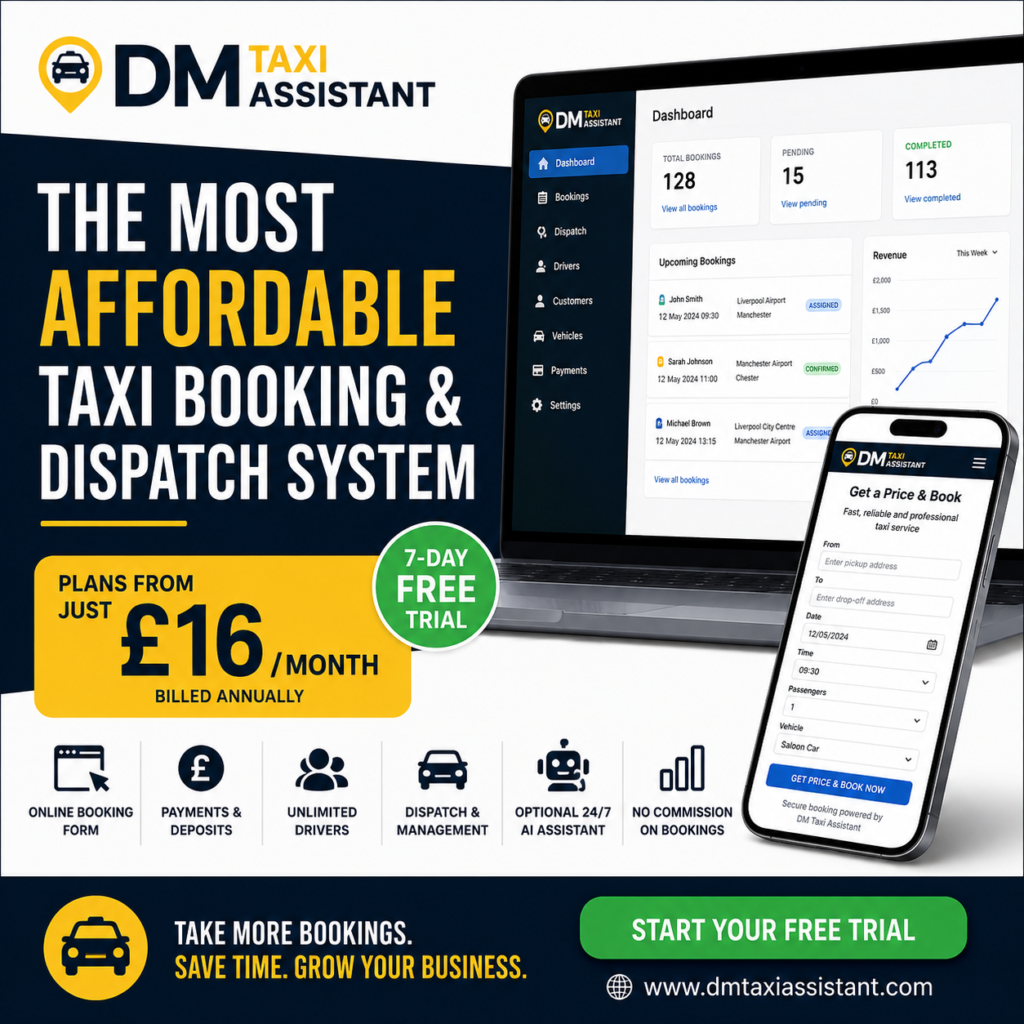
DM Taxi Assistant is designed for taxi, private hire, chauffeur and airport-transfer businesses and provides online pricing, booking, payments, enquiries, driver allocation and dispatch.
Current pricing and trial information are shown on the live DM Taxi Assistant website rather than being fixed into this guide, because software plans can change.
Our How to Take Taxi and Private Hire Bookings Online guide explains the complete booking workflow.
Cost 18: Card-processing fees
If passengers pay online or by card, there will normally be payment-processing costs.
These are often relatively small individually but become significant as turnover grows.
Calculate them as a normal business expense.
Do not base your pricing on receiving every penny of the customer fare.
Cost 19: Telephone
You may want:
- dedicated mobile
- business SIM
- virtual number
- call-forwarding
- call-recording system where lawful
- larger telephone platform
A one-person company can start very simply.
A larger operation taking hundreds of calls may need considerably more infrastructure.
Cost 20: Advertising and marketing
Technically, you can start marketing for very little.
You can build:
- website
- Google presence
- social media
- reviews
- referrals
without spending heavily on advertising.
But paid marketing could include:
- Google Ads
- Facebook or Instagram ads
- leaflets
- business cards
- local sponsorship
- signs
Do not assume advertising spend guarantees profitable bookings.
Track where customers come from.
Our How to Get More Taxi and Private Hire Bookings guide covers the wider marketing strategy.
Cost 21: Operating premises
A home-based operator may avoid commercial rent entirely if their licensing authority and other relevant rules permit the arrangement.
A larger taxi business might need:
- office
- taxi base
- parking
- utilities
- business rates
- broadband
- furniture
- signage
Premises can transform a relatively low-cost startup into a much more expensive operation.
Do not rent an office simply because you think a “real taxi company” must have one.
Check whether it is actually necessary for your licence and business model.
Cost 22: Staff
An owner-driver can handle much of the business personally at first.
As the operation grows, you might need:
- dispatcher
- administrator
- telephone staff
- bookkeeper
- employed drivers
Staff costs can include more than wages.
Employers may also face:
- National Insurance
- pension duties
- payroll
- holiday entitlement
- employers’ liability insurance
Do not add permanent staff before the booking volume can support them.
Cost 23: Driver payments
If you use other drivers, customer revenue is not all your money.
Drivers may be paid through:
- fixed amount
- percentage
- commission arrangement
- other agreed model
Calculate what remains for the operator.
A £100 booking where £80 is paid to the driver does not give the company £100 of profit.
Driver payments need to be built into your fare structure from the start.
Cost 24: Data protection
Taxi businesses process personal information including:
- names
- telephone numbers
- email addresses
- pickup addresses
- destinations
- travel dates
You should understand your obligations under UK data-protection law.
Depending on your circumstances, you may need to pay the Information Commissioner’s Office data-protection fee.
It is not normally one of the largest costs, but it belongs in the setup checklist.
Cost 25: Working capital
This is the cost many startup budgets completely miss.
Do not calculate only what it costs to get the first booking.
Ask:
How much money does the business need to survive until bookings become consistent?
You may have to pay:
- insurance
- vehicle finance
- fuel
- repairs
- software
- telephone
- accounting
before revenue becomes predictable.
Keep a cash reserve.
Starting a business with exactly enough money to obtain the licences leaves no room for a tyre, breakdown or quiet month.
A real London licensing example
To show why there is no simple UK-wide answer, consider a small London private hire owner-driver who needs all three elements from scratch.
Using current TfL fees:
Private hire operator licence for 0–10 vehicles: £2,000 over five years
PHV driver application and grant: £343
PHV vehicle application and grant: £140
That is already £2,483 in headline operator, driver and vehicle licence fees.
It does not include:
- driver assessments
- DBS
- medical
- vehicle
- insurance
- maintenance
- fuel
- website
- booking system
- accounting
- working capital
This is why somebody quoting “£500 to start a taxi company” without knowing the location and circumstances is not giving you a reliable answer.
Outside London, licensing costs can be completely different.
Example 1: Existing driver starting small
Imagine you already have:
- private hire driver licence
- licensable vehicle
- suitable insurance experience
- home-based operating setup
Your additional startup costs may concentrate on:
- operator licence
- vehicle licensing if not already complete
- insurance adjustment
- website
- booking system
- payment setup
- accounting
- working capital
This is one of the cheapest routes into operating your own business.
Example 2: Starting completely from scratch
Now imagine you need:
- driver licence
- DBS
- medical
- assessments
- operator licence
- vehicle licence
- vehicle deposit
- hire-and-reward insurance
- website
- booking technology
- working capital
That can quickly become a several-thousand-pound project even before the full cost of the financed vehicle is considered.
Example 3: Executive or chauffeur startup
A chauffeur operation may require much more capital because the vehicle itself can be considerably more expensive.
You may also spend more on:
- vehicle presentation
- premium insurance
- meet-and-greet work
- professional branding
- backup vehicle arrangements
Read our How to Start a Chauffeur Business in the UK guide if this is your target market.
Example 4: Small fleet
Starting with several vehicles adds costs very quickly.
You may need:
- multiple vehicle deposits
- multiple insurance policies or fleet insurance
- driver recruitment
- booking and dispatch technology
- additional working capital
- staff
- office or parking
- larger operator-licence fees in some areas
Do not build a five-car business simply because a five-car business looks more impressive.
It is often safer to start with one vehicle and add capacity when real demand exists.
Should you buy a car before getting the operator licence?
Be careful.
You need to know whether the vehicle will be accepted by the licensing authority and whether the wider business can legally operate.
Buying an expensive vehicle before confirming licensing requirements creates unnecessary risk.
Check:
- vehicle eligibility
- licence application process
- operating address
- planning requirements where relevant
- insurance availability
before making major financial commitments.
How much money should you keep in reserve?
There is no universal figure.
Think in terms of business survival rather than an arbitrary number.
Ask how you would pay for:
- insurance renewal
- unexpected repair
- tyre replacement
- finance payment
- slow month
- temporary replacement vehicle
if bookings stopped or the vehicle was off the road.
The more fixed monthly costs you have, the larger the reserve should generally be.
Do you need to be VAT registered from the start?
Not necessarily.
HMRC currently requires VAT registration if taxable turnover for the previous 12 months goes over £90,000 or if you expect it to exceed £90,000 within the next 30 days under the relevant rules.
Businesses can also register voluntarily below the threshold.
A growing private hire company can approach the threshold more quickly than expected, particularly if all bookings are taken through the operator and other drivers complete significant volumes of work.
Turnover is not profit.
Monitor it regularly.
Tax-check costs and administration
First-time licensing applicants may need to confirm that they are aware of their tax responsibilities.
Existing licence holders can be required to complete an HMRC tax check when renewing certain taxi, private hire or operator licences or applying for the same type of licence with another licensing authority.
The check itself is an administrative requirement rather than a substitute for paying tax.
Keep your tax records organised from the start.
Can you reduce startup costs?
Yes, without cutting corners on safety or licensing.
Ways to keep the initial investment lower can include:
- start with one vehicle
- use an existing eligible vehicle
- work from home where permitted
- avoid unnecessary office space
- use a free website
- choose booking technology suited to your actual size
- delay hiring staff until required
- grow through direct bookings before adding vehicles
The parts you should not cut corners on include:
- licensing
- insurance
- vehicle condition
- maintenance
- legal compliance
Saving £500 by operating without the correct cover is not a saving.
Your startup budget worksheet
Before launching, create a list containing:
Licensing
- Driver licence
- Operator licence
- Vehicle licence
- DBS
- Medical
- Training and tests
Vehicle
- Deposit or purchase
- Finance
- Insurance
- Service
- Tyres
- Licensing preparation
- Breakdown cover
Business
- Company setup if applicable
- Bank account
- Accountant
- Telephone
- Website
- Domain
- Booking software
- Card-processing setup
- ICO fee if applicable
Operating
- Fuel or charging
- Airport charges
- Parking
- Advertising
- Driver payments
- Working capital
Then add a contingency.
If the business only works financially when absolutely nothing goes wrong, the budget is too tight.
What should you read next?
For the practical startup process, read:
How to Start a Taxi or Private Hire Business in the UK
Taxi Operator Checklist: Everything You Need Before Taking Bookings
How to Set Taxi and Private Hire Fares
How to Take Taxi and Private Hire Bookings Online
If you want to keep the technology side affordable, DM Site Builder provides a free website option, while DM Taxi Assistant provides online booking, pricing, payments and driver-dispatch tools for taxi and private hire operators.
The cheapest way to start is not always the best way to start.
But you also do not need a fleet, office and expensive technology on day one.
Start with the licences and equipment you genuinely need, keep enough cash in reserve and add costs only when the bookings justify them.
Thanks for visiting DM News! If you’ve got a question, a story tip, or anything you’d like to share, head over to DriverMatty.com — I love to hear from you. While you’re there, don’t forget to check out my other websites and social media channels.
Sources
Operator Licences for Private Hire Vehicles — GOV.UK
Private Hire Operator Licence Fees — Transport for London
Taxi and Private Hire Licence Fees Notice 05/26 — Transport for London
DBS Reduces Fees From 5 October 2026 — GOV.UK
Confirm Your Tax Responsibilities When Applying for a Taxi or Private Hire Licence — GOV.UK
Complete a Tax Check for a Taxi or Private Hire Licence — GOV.UK




