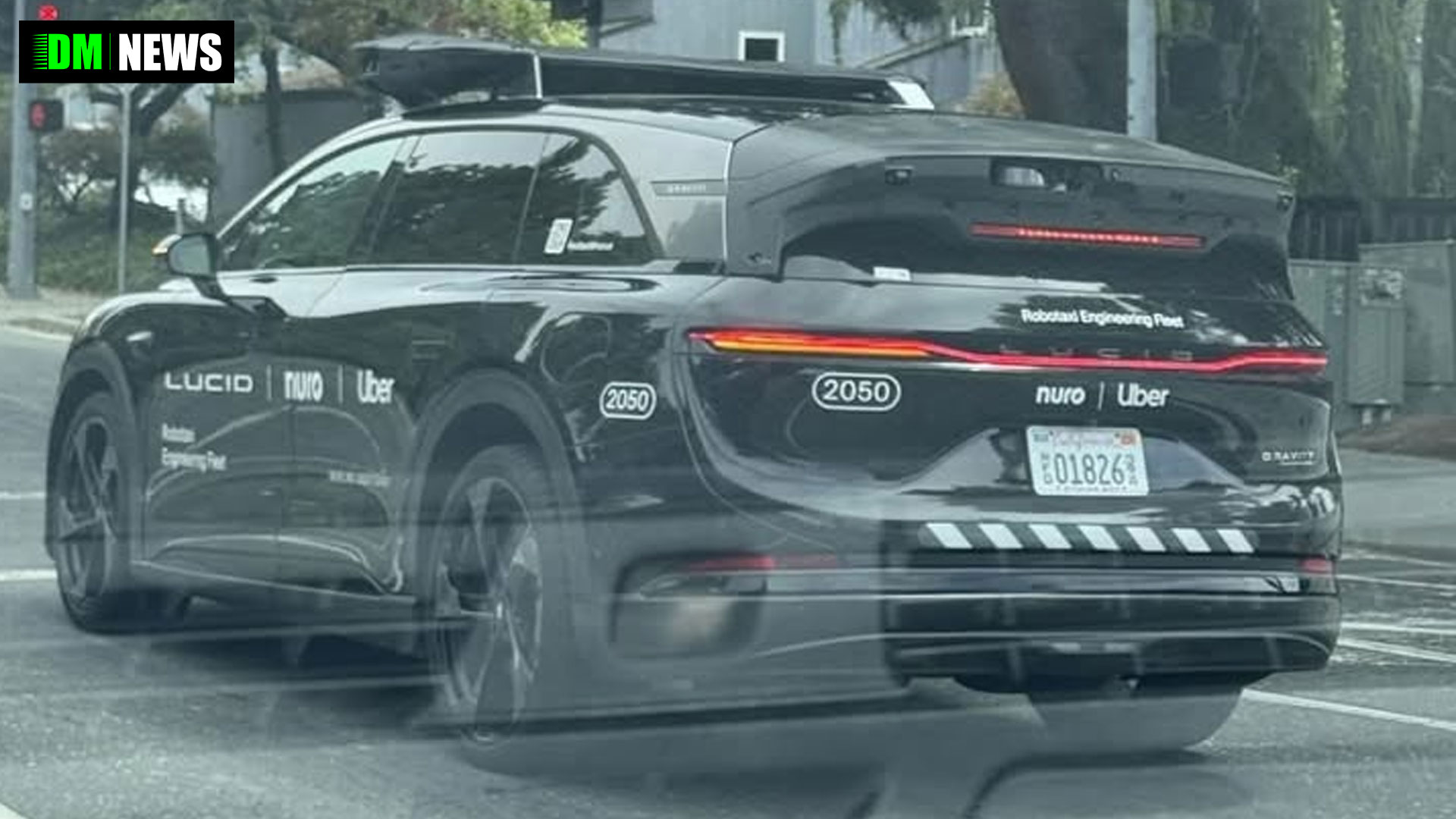
Driver Matty was sent a picture this week of an Uber-branded Lucid robotaxi out on the streets of California — no driver, just rolling along like it belonged there. He’s done a video about it on Facebook because, frankly, what’s happening over in the States right now is the clearest signal yet of where this trade is heading in the UK. And it’s a lot sooner than most drivers think.
What’s actually launched
The vehicle in the picture is part of a three-way deal between Uber, Lucid (the luxury EV maker) and Nuro (a self-driving tech company). The Lucid Gravity is the SUV, Nuro provides the brain that drives it, and Uber owns the rider relationship.
According to TechCrunch, the California DMV has modified Nuro’s existing driverless permit to include the Lucid Gravity, allowing it to be tested on public roads without a human safety operator behind the wheel. Engadget reports the testing is approved at speeds up to 45 mph, day or night, in Santa Clara and San Mateo counties.
Important to be straight on one thing: this is testing, not paid rides yet. Electrek confirms that before Uber can actually offer paid driverless rides to the public, Nuro still needs two more approvals — a deployment permit from the California DMV and a driverless ride-hailing permit from the California Public Utilities Commission. Neither has been filed yet.
But the picture Matty was sent shows the car already physically operating without a driver. The wheels are turning, in every sense.
The scale of what Uber’s building
This isn’t a small pilot. According to TechCrunch, the original July 2025 deal had Uber investing $300 million in Lucid and ordering 20,000 robotaxi-ready Gravity vehicles. That has now been expanded to $500 million and a minimum of 35,000 robotaxis, with at least 10,000 Gravity SUVs and 25,000 vehicles built on Lucid’s upcoming mid-size platform.
Engadget reports the wider Uber plan is to deploy 100,000 driverless vehicles across the US, with up to 35,000 of those powered by Nuro’s tech alone. Lucid has already delivered 75 engineering vehicles to Nuro and Uber, with testing happening in several US cities.
This is the biggest single bet on autonomous driving Uber has ever made. They’re not dipping a toe in — they’re cannonballing.
What about Waymo and the rest of the field
Uber and Lucid aren’t first to the party in California. Electrek notes that Waymo has held all the necessary permits and has been offering paid, fully driverless rides in San Francisco for years. Amazon-owned Zoox is also planning to launch a paid robotaxi service in San Francisco in the second half of 2026. So the competitive pressure is real — and it’s a big part of why Uber is pushing this hard.
The Engadget reporting on the Lucid Gravity prototype is worth a look on its own. The vehicle features a multi-pronged sensor system including high-resolution cameras, lidar sensors, and radar, along with a roof-mounted LED display so people on the street know what the car is doing.
Now the bit UK drivers need to read
Here’s where it gets serious for anyone driving for Uber in the UK. This isn’t a “five or ten years away” story any more. It’s a “by next year” story.
According to Fleet News, the UK’s Automated Vehicles Act became law in May 2024. That Act delivered the legal framework setting out liability for autonomous vehicles — meaning drivers can’t be held responsible for how a vehicle drives while it’s in self-driving mode — but it needs secondary legislation to fully unlock driverless cars on UK roads.
That secondary legislation is being worked on right now. Zag Daily’s timeline lays it out clearly: pilot schemes for autonomous commercial services, including taxis, are expected to be permitted in the first half of 2026, with regulated public trials beginning subject to approvals. Further consultation on the regulatory framework is expected in the second half of 2026, with full self-driving vehicle regulations expected to be in force in the second half of 2027.
And the major players are already lining up at the door:
- Waymo is planning its first European driverless taxi service in London, aiming for a 2026 launch, using Jaguar I-Pace vehicles and a fleet partner called Moove
- Uber is planning UK driverless trials and has partnerships with Wayve, Lyft and Baidu
- Baidu’s Apollo Go RT6 robotaxis are set to be trialled in London in 2026 by Uber and Lyft, subject to regulatory approval
According to Eleport, the UK government has explicitly talked about driverless taxis and shuttles on British roads by 2026, with a fuller rollout as the Automated Vehicles Act is implemented by 2027.
What this actually means if you drive for Uber here
Let’s not sugarcoat it. The honest read of the situation is this: Uber is investing half a billion dollars and ordering 35,000 driverless vehicles in the US, while in the UK the legal framework is being built around them to do the same thing here. The trials being planned for London in 2026 will use the exact same playbook — limited area, safety driver at first, then fully driverless.
Nobody knows the exact pace. Robotaxis won’t replace 80,000 London PHV drivers overnight — the trials are starting in defined zones with defined conditions, what’s called Level 4 autonomy. They struggle in bad weather, in edge cases, and outside the geofenced areas they’ve been trained on. Zag Daily notes that nearly all current robotaxis are still supervised remotely through teleoperation, with human operators stepping in when the car gets stuck.
But the direction of travel is one-way. The cars in the picture Matty was sent are real, they’re on real roads, and the legal and commercial wheels are already turning to put them on UK roads too.
What can drivers do?
A few honest thoughts:
- Don’t panic, but don’t ignore it either. This is happening on a timescale of years, not decades. Anyone planning a long-term career purely in private hire driving needs to be thinking about what their next chapter looks like.
- Diversify your income where you can. Drivers who’ve built their own brand, their own bookings, their own loyal customer base will have far more resilience than drivers who are 100% reliant on a single app sending them work.
- Watch the politics carefully. The regulatory framework being drafted right now will decide a lot — including whether trials will be required to have safety drivers, what zones they can operate in, and how quickly fully driverless services can scale up.
- Stay informed. This is one of the biggest changes the trade has ever seen, and it’s going to happen in the open, with consultations, trials, and public debate. Drivers who are switched on will adapt; drivers who pretend it isn’t happening won’t.
The picture Matty was sent isn’t science fiction. It’s a normal Tuesday in California. And in not very long at all, it might be a normal Tuesday in London too.
Thanks for visiting DM News! If you’ve got a question, a story tip, or anything you like to share, head over to DriverMatty.com — I love to hear from you. While you’re there, don’t forget to check out my other websites and social media channels.
Sources:
- Nuro receives driverless testing permit ahead of Uber robotaxi service launch — TechCrunch
- Nuro secures California driverless permit for Lucid Gravity Uber robotaxis — Electrek
- Nuro approved to test its driverless Uber robotaxis on California roads — Engadget
- Lucid, Nuro and Uber announce global robotaxi program (SEC Form 8-K) — U.S. Securities and Exchange Commission
- Uber and Lyft to launch UK driverless taxi trials in 2026 — Fleet News
- London’s robotaxi trials: What we know so far — Zag Daily
- The Electric Robotaxi Revolution Is Arriving In Europe In 2026 — Eleport