

Choosing a taxi booking system can become one of the biggest technology decisions a private hire operator makes.
For a one-car airport-transfer business, the priority might simply be taking online bookings, calculating fares and sending jobs to a driver.
A larger private hire company may need automated dispatch, driver apps, passenger apps, corporate accounts, call automation, live vehicle tracking and detailed reporting.
That is why there is no single taxi booking system that is automatically best for every operator.
The right question is:
What does your business actually need the software to do?
This guide explains what taxi, private hire, chauffeur and airport-transfer operators should compare before choosing a booking and dispatch system.
If you are only just moving bookings online, also read our How to Take Taxi and Private Hire Bookings Online guide.
What is taxi booking and dispatch software?
Taxi booking software provides a central place for an operator to manage passenger journeys.
Depending on the system, it may handle:
- telephone bookings
- website bookings
- passenger apps
- customer enquiries
- automatic quotations
- driver allocation
- dispatch
- online payments
- customer accounts
- corporate accounts
- driver records
- recurring bookings
- customer notifications
- reporting
More advanced fleet-management systems can also include live vehicle positioning, automated dispatch rules, driver apps, call-centre tools and integrations with other transport platforms.
The important thing is not having the longest list of features.
It is having the features your business will actually use.
Start by deciding what size system you need
A one-car operator and a 300-car fleet should not necessarily be buying the same product.
Owner-driver or very small private hire business
The priorities may be:
- online booking form
- instant pricing
- customer records
- deposits
- card payments
- booking dashboard
- simple driver allocation
You may not need an expensive passenger app or sophisticated automatic dispatch engine.
Small or growing fleet
As additional drivers are added, you may need:
- driver management
- dispatch
- driver payment calculations
- several vehicle types
- account customers
- better reporting
- driver communication
Large taxi or private hire fleet
Larger operators may need:
- advanced automatic dispatch
- driver apps
- passenger apps
- live vehicle tracking
- call-centre integration
- multiple operating zones
- corporate-account portals
- automated telephone bookings
- complex dispatch rules
- fleet analytics
- multiple companies or operating centres
Do not pay for enterprise technology simply because it looks impressive in a demonstration.
Equally, do not choose a basic system that you will outgrow within six months if rapid expansion is already planned.
1. Online booking should be easy for passengers
Start with the customer.
Can they actually make a booking without becoming frustrated?
A useful online form should make it easy to enter:
- pickup
- destination
- date
- time
- passengers
- luggage
- vehicle
- return journey
- contact details
Airport operators may also need:
- flight number
- terminal
- arrival details
- meet and greet
Test the booking system yourself on a mobile phone.
The passenger should not need to complete an unnecessarily complicated form just to book a straightforward journey.
2. Check how the system handles pricing
Pricing can vary enormously between taxi companies.
Your booking software should ideally work around your business rather than forcing your business to use one basic fare calculation.
Useful pricing options can include:
- minimum fares
- price per mile
- mileage tiers
- time
- zones
- fixed journeys
- airport rates
- vehicle-specific pricing
- night rates
- additional stops
- waiting
- surcharges where lawful and appropriate
For example, an airport-transfer operator might use fixed prices from its main towns to Manchester Airport while using mileage calculations for unusual long-distance jobs.
A large local private hire company might rely more heavily on zones and detailed tariffs.
Before choosing a system, take several real journeys your company sells and ask the supplier to show you exactly how each would be priced.
Do not rely on a salesperson simply saying:
Yes, it can do flexible pricing.
See it working.
Our Taxi and Private Hire Pricing Guide explains how to create the underlying fare structure first.
3. Look at dispatch, not just booking
A system can have a beautiful passenger booking form and still create problems behind the scenes.
Once the customer books, somebody needs to complete the journey.
Ask how the platform handles:
- unallocated bookings
- driver allocation
- driver availability
- vehicle availability
- future bookings
- urgent bookings
- job status
- reassignment
- driver rejection
- multiple drivers
- multiple vehicles
A one-car operator may only need to press one button to assign a job.
A large fleet could need automatic dispatch based on factors such as vehicle location, operating zone, queue position or estimated arrival time.
Systems such as iCabbi, Autocab, TaxiCaller and Cordic offer more advanced fleet-dispatch capabilities for operators that need them.
Smaller operators should decide whether that sophistication is genuinely necessary.
4. Check the driver experience
Drivers need to receive accurate information quickly.
Ask what the driver sees when a journey is allocated.
Useful information may include:
- passenger name
- telephone number
- pickup
- destination
- date
- time
- fare
- payment status
- passengers
- luggage
- flight details
- customer notes
Large systems may provide a dedicated driver app with navigation, job status, offers and live communication.
A small operator may prefer a simpler workflow.
There is no benefit in buying an advanced driver application if your three drivers would rather receive clear booking details through a simpler process.
But once you operate dozens of vehicles, proper driver software can become much more important.
5. Can it take payments?
Online payments can remove a lot of administration.
Check whether the system supports:
- full prepayment
- deposits
- pay on the day
- card payments
- payment status
- refunds where required
Also understand which payment provider is used and what separate transaction fees apply.
The software subscription price is not necessarily the total cost of taking a card payment.
Airport and long-distance operators may particularly value deposits because one booking can reserve several hours of a driver’s day.
6. Does the booking system work with your website?
Your website and booking software should work together.
A customer should ideally be able to move from:
Google search
to:
your website
to:
price
to:
booking
without being sent through an unnecessarily confusing process.
Check whether the system can be:
- embedded into your website
- linked from your website
- branded for your business
- used through a hosted booking page
If you still need the website itself, read our How to Build a Taxi Website That Gets Bookings guide.
DM Site Builder also provides a free website option for taxi, private hire, chauffeur and airport-transfer businesses.

7. Look closely at booking records
Booking records are not just useful for running the company.
For private hire operators they can also be a licensing requirement.
Department for Transport statutory standards recommend recording information including the passenger, pickup, destination, driver, driver licence number and vehicle registration, alongside information about the individuals responding to and dispatching bookings.
Your local licensing authority can impose its own detailed conditions.
London private hire operators also have specific TfL record requirements.
Before buying any booking system, ask:
Can I retrieve the records my licensing authority expects me to keep?
Do not simply assume that because software is marketed to taxi companies it automatically satisfies every condition imposed by your particular authority.
The operator remains responsible for compliance.
8. Can you search old bookings easily?
Imagine a passenger calls about a journey completed three months ago.
Can you quickly find it?
A good system should allow you to search bookings by useful information such as:
- booking reference
- customer
- telephone number
- date
- pickup
- driver
- vehicle
This becomes increasingly important as booking volume grows.
Twenty jobs are easy to remember.
Twenty thousand are not.
9. Look at customer communication
Automatic communication can save a surprising amount of time.
Depending on the platform, passengers may be able to receive messages when:
- booking is confirmed
- driver is assigned
- vehicle is approaching
- booking changes
- journey is completed
Larger platforms can provide much more sophisticated automated communication.
For a small operator, even a clear booking confirmation can significantly improve the customer experience.
Ask what is included in the normal subscription and what requires additional SMS, email or communication charges.
10. Do you need a passenger app?
Passenger apps can be valuable for larger local taxi fleets where customers book repeatedly.
They may allow customers to:
- book journeys
- save addresses
- obtain fare estimates
- track vehicles
- make payments
- view previous journeys
But an app is not automatically necessary for every company.
A customer booking an airport transfer twice a year may be perfectly happy using your mobile website.
Before paying for an app, ask:
Will enough customers genuinely download and use it?
A good online booking experience can sometimes be more valuable to a smaller operator because the passenger does not need to install anything.
11. Do you need a corporate-account portal?
Business accounts can become very important to larger operators.
If corporate work is part of your strategy, investigate whether the system can handle:
- account users
- departments
- journey restrictions
- cost centres
- monthly invoicing
- reporting
- account booking
- guest bookings
Platforms such as iCabbi and Autocab provide dedicated tools aimed at managing corporate-account work.
A small airport-transfer operator with three business clients may not need that level of functionality yet.
Again, match the software to the actual operation.
12. Can the system grow with you?
Think beyond today’s number of vehicles.
If you have two drivers now but expect 20 within two years, ask:
- How are additional drivers charged?
- Is there a vehicle limit?
- Can several dispatchers use it?
- Can you create additional operating areas?
- Can the system manage several companies?
- Can functionality be added later?
Migration between taxi dispatch platforms can be disruptive.
That does not mean you should massively overspend today, but you should understand the path available if the company grows.
13. Look for automation that solves a real problem
Automation is useful when it removes repetitive work.
Examples can include:
- automatic pricing
- automatic booking confirmation
- automatic dispatch
- repeat bookings
- passenger notifications
- driver-document reminders
- invoicing
- answering routine customer questions
But automation should have a purpose.
Do not choose a system because its brochure contains the most uses of the word AI.
Ask what the technology actually does and how many hours of work it could realistically save your business.
14. What about AI booking assistants?
AI is beginning to play a bigger role in customer booking.
A useful AI assistant can potentially answer questions such as:
Do you have a six-seater?
How much is Liverpool to Manchester Airport?
Can I pay the driver?
It can then move the passenger towards a booking.
The important issue is accuracy.
A taxi AI assistant should use information and prices supplied by the operator rather than inventing fares or policies.
It should also know when to stop and send something to a human.
DM Taxi Assistant includes an optional AI customer assistant alongside its booking and dispatch system.
It can answer customers using the operator’s configured information and pricing and can turn conversations into bookings or enquiries.
If it is not confident enough to answer, it can hand the enquiry back to the operator rather than simply guessing.
15. Compare the complete cost, not just the monthly price
Taxi systems can use very different pricing models.
Potential charges can include:
- monthly subscription
- per vehicle
- per driver
- per booking
- payment fees
- SMS charges
- passenger app
- setup
- training
- integrations
- additional modules
- support
- contract termination
A system advertised at a low headline price may become expensive once 50 vehicles and several optional products are added.
Equally, an enterprise system may provide functionality that genuinely saves a large fleet enough money to justify its higher cost.
Calculate the total cost for your actual business.
16. Understand contract length
Before signing, check:
- minimum term
- notice period
- cancellation
- price increases
- data export
- setup costs
- hardware commitments
Changing a booking platform after it becomes central to the business can be difficult.
Read the agreement rather than relying entirely on the demonstration.
17. Check what happens to your data
Your booking system may contain:
- passenger names
- telephone numbers
- addresses
- journey history
- driver details
- payment information
- corporate accounts
Ask:
- Where is the information stored?
- Can you export your bookings?
- What happens if you leave the platform?
- How is access controlled?
- Can staff permissions be restricted?
You remain responsible for handling personal information appropriately even when another company provides the software.
18. Support matters more than operators think
Booking software is not like a photo-editing app.
If it stops working on a busy Saturday night, your business may be affected immediately.
Investigate:
- support hours
- emergency support
- telephone support
- live chat
- knowledge base
- onboarding
- training
A cheap system that nobody can help you fix when it fails may become extremely expensive.
Larger operators should also ask suppliers about uptime commitments, incident handling and business continuity.
19. Ask for a real demonstration
Do not only watch a polished promotional video.
Give the supplier scenarios from your own business.
For example:
Show me how you would price a saloon from my town to Heathrow at 4am.
Now add a return journey.
Now change it to an eight-seater.
Now assign it to one of my drivers.
Now show me what the driver sees.
Now find that booking six months later.
A good demonstration should follow your workflow rather than simply showing the supplier’s favourite features.
20. Use a free trial where possible
A trial can be far more valuable than a sales call.
Test the system with actual examples from your business.
Create dummy journeys.
Try:
- local bookings
- airport bookings
- long-distance jobs
- returns
- additional stops
- multiple vehicles
- payments
- driver allocation
Then ask the people who will actually use it what they think.
The owner may love a system that dispatchers or drivers hate.
Different systems suit different operators
The taxi software market includes several different types of product.
Large fleet platforms
Systems such as iCabbi and Autocab provide extensive booking, dispatch and fleet-management ecosystems.
Their official product information includes features such as advanced dispatch, driver and passenger apps, corporate-account tools, automated bookings and fleet-management functionality.
These kinds of systems may be particularly attractive to established operators that need substantial automation and fleet control.
Cloud-based dispatch platforms
TaxiCaller provides a cloud-based dispatch platform including dispatch, online booking, passenger and driver apps and real-time vehicle management.
Cordic also provides taxi dispatch technology aimed at professional fleets, with tools covering automated bookings, driver productivity and fleet management.
Smaller operators and owner-drivers
A smaller operator may not need all of that infrastructure.
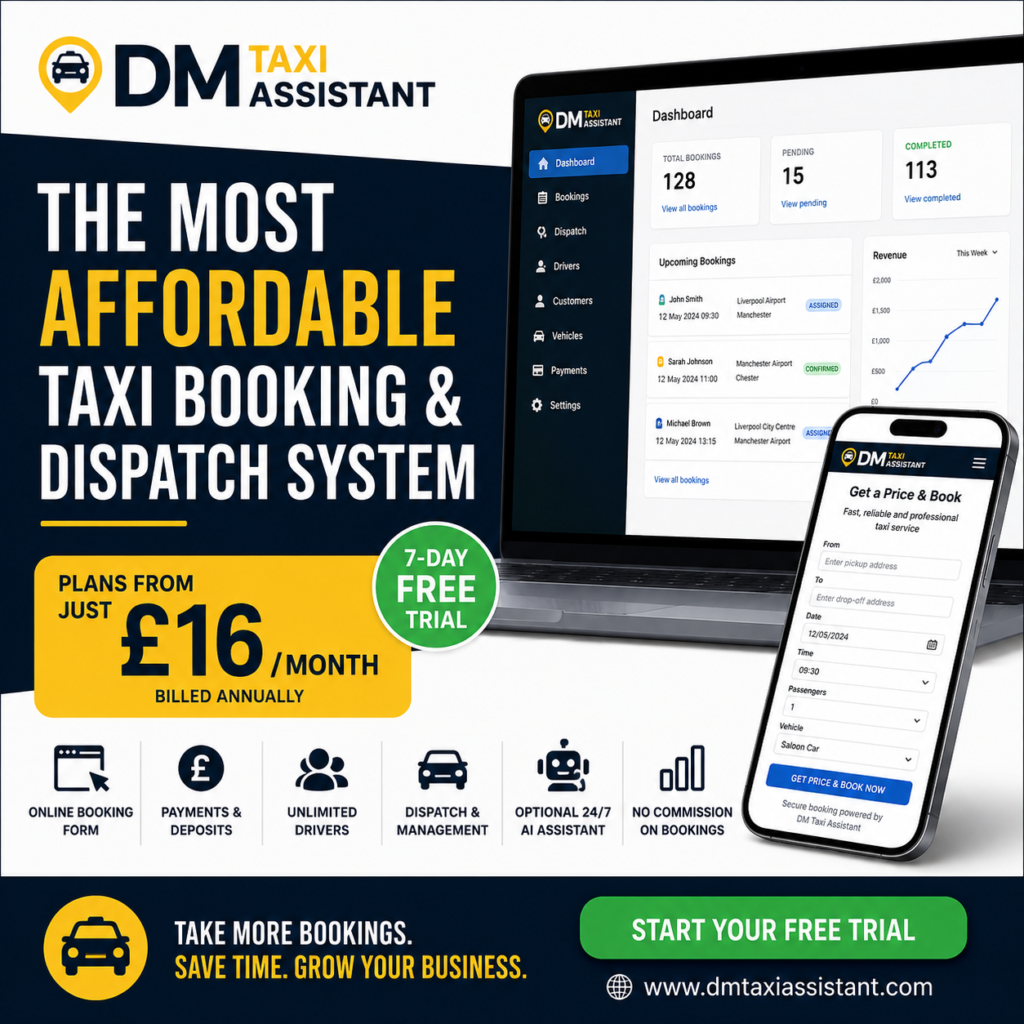
DM Taxi Assistant is designed to provide taxi, private hire, chauffeur and airport-transfer businesses with a more straightforward booking and dispatch setup.
Its current booking and dispatch system includes:
- website booking form
- instant prices from your own tariff
- vehicle choices
- return bookings
- card payments or pay on the day
- booking dashboard
- unlimited drivers
- driver allocation
- driver percentage calculations
- customer and enquiry records
An optional AI assistant can then be added for businesses that want customer questions, quotations and enquiries handled automatically.
Current plans and trial information are available directly on the DM Taxi Assistant website.
Which taxi booking system should you choose?
Rather than looking for a universal winner, shortlist systems against your actual requirements.
Ask:
How many vehicles do I have?
How many will I realistically have in two years?
Do customers mainly book online or by phone?
Do I need automatic dispatch?
Do I need a passenger app?
Do I need corporate accounts?
Do I need AI customer service?
How complicated is my pricing?
What records must I retain?
What is my actual monthly budget?
The best answer for a one-car chauffeur company may be completely different from the best answer for a 500-car private hire fleet.
Taxi booking system checklist
Before choosing a platform, check:
- Online booking form
- Mobile usability
- Address autocomplete
- Your own pricing rules
- Minimum fares
- Vehicle pricing
- Fixed airport pricing
- Zones where needed
- Return bookings
- Passenger and luggage information
- Payment options
- Deposits
- Booking confirmation
- Booking records
- Searchable booking history
- Driver management
- Vehicle management
- Driver allocation
- Dispatch
- Driver communication or app
- Passenger app if required
- Corporate accounts if required
- Reporting
- Customer communication
- User permissions
- Data export
- Data protection
- Support hours
- Training
- Setup charges
- Monthly costs
- Additional fees
- Contract length
- Cancellation terms
- Scalability
Do not choose software because another taxi company uses it.
Choose it because it fits the way your company needs to work.
What should you read next?
If you are currently moving from manual bookings into proper software, read:
How to Take Taxi and Private Hire Bookings Online
How to Set Taxi and Private Hire Fares
How to Get More Taxi and Private Hire Bookings
How to Build a Taxi Website That Gets Bookings
For small and growing operators that want to try a simpler booking and dispatch setup, DM Taxi Assistant offers online bookings, operator-controlled pricing, payments, enquiries and driver dispatch, with an optional AI customer assistant.
If you still need the customer-facing website as well, DM Site Builder provides a free website option.
Taxi booking software should make the operation simpler.
If the system costs more, creates more administration and makes life harder for passengers, drivers and operators, having more features does not automatically make it better.
Start with the problems you need to solve, then choose the technology that solves them.
Thanks for visiting DM News! If you’ve got a question, a story tip, or anything you’d like to share, head over to DriverMatty.com — I love to hear from you. While you’re there, don’t forget to check out my other websites and social media channels.
Sources
Statutory Taxi and Private Hire Vehicle Standards — Department for Transport
Private Hire Operator Licence and Booking Records — Transport for London
Private Hire Operator Register and Booking Records Guidance — Transport for London




