

Starting an airport transfer business can be an attractive route into the taxi and private hire industry.
Instead of relying mainly on short local journeys, an airport-transfer company can focus on higher-value pre-booked work, including airport pickups, airport drop-offs, long-distance journeys, executive travel, families, groups and business travellers.
You can also start relatively small.
Many airport-transfer businesses begin with one licensed driver and one vehicle before gradually adding repeat customers, additional vehicles and other licensed drivers.
However, an airport-transfer company is not simply a normal business that happens to drive people to airports.
Passenger transport is regulated, and you need to make sure the driver, vehicle, booking operation and insurance are all correctly licensed for the work you intend to undertake.
You also need to understand airport pickup rules, flight delays, parking charges, cancellations, pricing and how you will manage bookings that customers may make months in advance.
This guide explains the main steps involved.
If you are still at the licensing stage, also read:
How to Become a Private Hire Driver in the UK
How to Become a Private Hire Operator in the UK
And for the broader business setup:
How to Start a Taxi or Private Hire Business in the UK
What is an airport transfer business?
An airport transfer business transports passengers between airports and homes, hotels, businesses, cruise terminals, railway stations and other destinations.
The work is normally booked in advance.
Typical bookings might include:
- home to airport
- airport to home
- hotel to airport
- airport to hotel
- airport to airport
- cruise terminal to airport
- railway station to airport
- business travel
- executive airport transfers
- group airport transfers
- long-distance airport journeys
Unlike ordinary app work, many airport journeys are booked days, weeks or even months in advance.
That changes the way you need to run the business.
You need reliable booking records, flight details, passenger contact information, suitable vehicles, clear payment arrangements and a system for making sure somebody is available when the journey eventually happens.
Do you need a special airport-transfer licence?
There is no single UK-wide licence called an “airport transfer licence”.
Instead, the underlying passenger transport activity needs to be correctly licensed.
For many businesses, that means operating within private hire licensing.
In England and Wales, if you want to accept bookings for private hire vehicles, you will generally need the appropriate private hire operator licence.
You will also normally need appropriately licensed:
- drivers
- vehicles
- insurance
London private hire businesses are licensed by Transport for London.
Scotland operates a different taxi, private hire car and booking-office licensing system.
Northern Ireland also has its own taxi operator licensing system.
Taxi or Hackney carriage drivers can also carry pre-booked airport passengers, but taxi licensing and private hire licensing are not identical.
If you are unsure which structure applies to what you want to do, speak to your local licensing authority before taking bookings.
Step 1: Decide exactly what kind of airport-transfer business you want
Not every airport-transfer company has the same business model.
You might specialise in:
Standard airport transfers
Normal cars carrying individuals, couples and small families.
Group transfers
MPVs and larger vehicles for families and groups.
Executive airport transfers
Higher-end vehicles aimed at corporate travellers, executives and customers who want a premium service.
Chauffeur airport transfers
A more formal service that may include smartly dressed drivers, meet and greet and premium vehicles.
Nationwide long-distance transfers
Passengers travelling long distances between cities and major airports.
Local airport specialist
For example, a business concentrating primarily on passengers travelling between one town or city and its nearest major airports.
There is no requirement to choose only one.
But understanding the work you want will help you choose vehicles, prices, website pages and marketing properly.
Step 2: Sort out the licensing first
Do not build the entire business and then investigate licensing.
Licensing should come near the beginning.
If you are going to drive passengers yourself, make sure you hold the correct driver licence.
If you are using your own vehicle, make sure that vehicle can be licensed appropriately.
If you are accepting private hire bookings yourself in England or Wales, you will generally need an operator licence.
This is particularly important for airport transfers because customers will often contact the business directly through:
- your website
- telephone
- a booking form
The fact that the passenger booked through WhatsApp rather than your website does not remove licensing requirements.
The key issue is whether you are legally entitled to accept and fulfil that passenger booking.
For the full operator process, see our private hire operator guide.
Step 3: Choose the right business structure
Your airport-transfer business could potentially operate as:
- a sole trader
- a partnership
- a limited company
A one-car owner-driver may start as a sole trader.
A larger operation may prefer a limited company.
There is no single structure that is automatically best for every airport-transfer business.
Think about:
- tax
- accounting
- liability
- ownership
- future partners
- employing people
- business accounts
- growth plans
If you are unsure, speak with an accountant before deciding.
Whatever structure you choose should also fit correctly with the entity holding any required operator licence.
Step 4: Pick a good business name
Airport-transfer businesses rely heavily on people finding and remembering them.
Your name should ideally be:
- easy to say
- easy to spell
- easy to search
- suitable for a website
- suitable for Google
- professional enough for corporate work
Before choosing it, check:
- Companies House
- domain availability
- social-media usernames
- similar local transport businesses
- trade marks where appropriate
Think about your future plans too.
A name focused exclusively on one tiny local area may become restrictive if you later expand across a larger region.
Step 5: Choose a suitable vehicle
The best airport-transfer vehicle is not necessarily the cheapest vehicle to buy.
Airport passengers often travel with a considerable amount of luggage.
That means luggage capacity can be just as important as passenger capacity.
For example, a vehicle advertised as carrying seven passengers may not realistically accommodate seven passengers plus seven large suitcases.
Think about:
- passenger capacity
- boot space
- reliability
- fuel economy
- comfort
- vehicle age
- licensing eligibility
- insurance
- maintenance
- motorway driving
- charging range if electric
- accessibility
Possible airport-transfer vehicle categories include:
- saloon
- estate
- MPV
- executive saloon
- executive MPV
- wheelchair-accessible vehicle
For larger vehicles, be particularly careful about passenger capacity and the licensing regime.
Private hire vehicle licensing through the standard taxi/PHV system generally relates to vehicles with no more than eight passenger seats.
Vehicles above that capacity can potentially fall under different passenger transport licensing requirements.
Always check before purchasing a larger vehicle.
Step 6: Arrange suitable insurance
You need insurance that covers the passenger transport work you are actually doing.
Ordinary personal car insurance is not enough for paid airport-transfer work.
You may need private hire or taxi hire-and-reward insurance.
Depending on the business, you might also consider:
- public liability
- employers’ liability where applicable
- breakdown cover
- replacement vehicle cover
- legal expenses
- office or business insurance
Tell the insurer exactly what you do.
If your work includes regular long-distance airport journeys, make sure your policy reflects your actual annual mileage and use.
Breakdown cover is particularly important.
Breaking down on the way to collect a passenger for a flight is much more serious than simply losing one local £10 fare.
Step 7: Learn the airports you intend to serve
Every airport is different.
Do not assume that because you know how to collect a passenger from one airport, another will operate the same way.
Airports can have different rules covering:
- drop-off areas
- pickup areas
- short-stay parking
- private hire holding areas
- waiting
- ANPR charges
- payment deadlines
- terminal access
- meet and greet
- permits
- concession schemes
Charges also change.
Build airport fees into your pricing rather than treating them as an unexpected expense.
You should regularly check the official airport website for each airport you serve.
Airport drop-off and pickup charges
Major UK airports increasingly charge for terminal drop-offs, pickups or parking.
For example, Heathrow currently charges vehicles entering its terminal drop-off zones, while pickups must take place elsewhere rather than in those drop-off areas.
Manchester Airport also operates specific paid pickup and drop-off areas and provides arrangements specifically for private hire operators.
These costs can quickly add up if you complete several airport journeys per day.
Decide whether:
- airport fees are included in your advertised fare
- you add them separately
- parking is included for a certain period
- additional parking is charged to the passenger
Make this clear before the customer books.
Step 8: Create airport-specific pricing
Airport transfers work well with fixed pricing because customers generally want to know the total cost before booking.
But fixed pricing only works if you understand your costs.
Your price may need to account for:
- mileage
- journey time
- empty mileage
- fuel or charging
- driver payment
- airport drop-off charge
- pickup parking
- meet-and-greet parking
- waiting
- tolls
- congestion charges
- vehicle type
- unsociable hours
Do not forget the return journey
Imagine you quote £120 for a journey to Heathrow.
The passenger sees a £120 booking.
But your business might see:
200 miles driven there and back, several hours of driver time, fuel or electricity, a terminal charge and vehicle wear.
This is why quoting only on the loaded mileage can leave airport-transfer companies doing apparently expensive journeys for very little profit.
Calculate the full job.
Step 9: Set up your airport booking system
Airport transfers are one of the worst types of business to manage through memory and random WhatsApp messages.
A customer might book today for a flight in six months.
By the time that journey happens, you need to know:
- passenger name
- contact information
- pickup address
- destination
- date
- pickup time
- flight number
- airport
- terminal
- passengers
- luggage
- vehicle
- fare
- payment status
- driver
- special requests
- return booking
One missed airport booking can seriously damage your reputation.
This is where DM Taxi Assistant is particularly relevant.
DM Taxi Assistant is designed specifically for taxi, private hire, chauffeur and airport-transfer businesses.
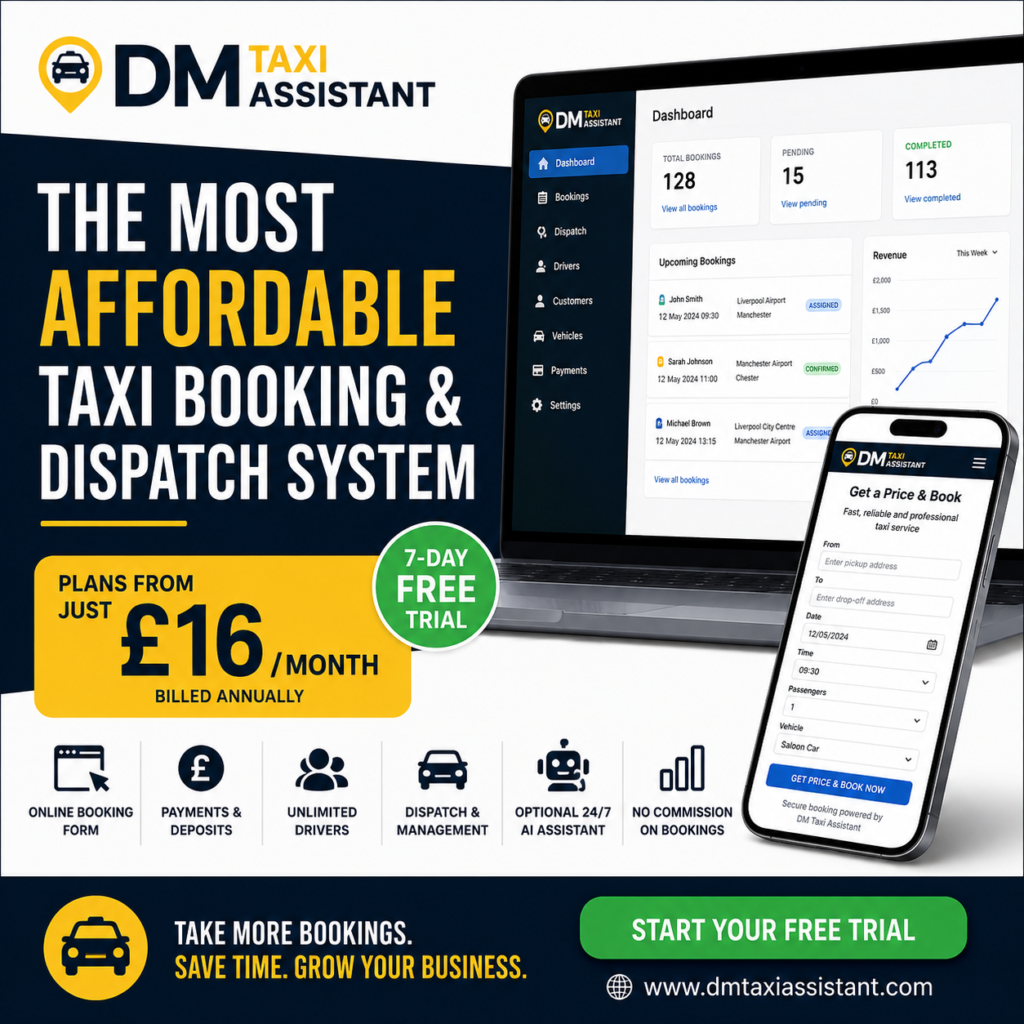
Its booking and dispatch system can provide:
- online booking forms
- instant prices using your own tariff
- different vehicle options
- return journeys
- passenger and luggage details
- card payments
- pay-on-the-day options
- a central booking dashboard
- driver allocation
- unlimited driver dispatch
- customer booking information
- an optional AI booking assistant
The booking and dispatch package currently starts from £16 per month when paid annually, with unlimited bookings and unlimited drivers.
There is also currently a 7-day free trial.
You configure the prices and rules for your own business.
The software does not decide how much you should charge.
For an airport-transfer operator, the aim is simple: get every booking out of messages and notebooks and into one system where it can actually be managed.
DM Taxi Assistant is a business tool, not a substitute for any operator, driver, vehicle or insurance licence legally required for your operation.
Step 10: Build a website designed to generate airport bookings
Airport transfers are particularly suited to Google searches.
Customers frequently search for specific journeys.
Examples might include:
- Liverpool to Manchester Airport taxi
- Manchester Airport to Chester transfer
- Birmingham to Heathrow taxi
- airport transfer near me
- Manchester Airport 8 seater
- Heathrow executive transfer
That gives an airport-transfer business a major opportunity to build pages around the actual services customers search for.
Your website should explain:
- airports covered
- areas covered
- vehicle choices
- passenger capacity
- luggage capacity
- pricing or quotation process
- meet and greet
- payment
- cancellations
- contact details
- how to book
Then create genuinely useful pages around your most important routes.
Do not create hundreds of almost identical pages by changing the town name.
Useful route pages should provide information that genuinely helps someone planning that journey.
Need a website?
If you are starting an airport-transfer business without a website, DM Site Builder offers a free website option.
You can create a professional mobile-ready website and then connect your booking process to DM Taxi Assistant.
That gives a new airport-transfer business two important parts:
DM Site Builder helps customers find and understand your business.
DM Taxi Assistant helps them quote, book and have their journey managed.
You can also use DM Taxi Assistant’s hosted booking option if you want to get your booking system running before your full website is ready.

Step 11: Decide how flight delays will work
Flight delays are normal.
Your terms need to explain what happens when a passenger’s aircraft arrives late.
Consider:
- whether you track flights
- when free waiting begins
- how much waiting is included
- when additional waiting charges start
- how airport parking is handled
- what happens if the flight is diverted
- what happens if the passenger changes flight
Avoid vague policies.
If you include 60 minutes of waiting, explain when that 60 minutes begins.
Is it:
- scheduled landing time?
- actual landing time?
- time the passenger enters arrivals?
Clarity helps prevent arguments.
Step 12: Decide whether to offer meet and greet
Meet and greet is often expected in the premium airport-transfer market.
Instead of telling the passenger to find the vehicle outside, the driver parks and meets them inside the terminal.
This can improve the customer experience but increases:
- parking costs
- driver waiting time
- time away from the vehicle
You therefore need to price it properly.
Decide whether meet and greet is:
- included
- an optional extra
- only offered with executive bookings
Also explain how the passenger identifies the driver.
This might include:
- passenger name board
- telephone contact
- SMS
- meeting-point instructions
Step 13: Take deposits or advance payment
Airport journeys can reserve several hours of a driver’s day.
A last-minute cancellation can therefore be expensive.
Many airport-transfer businesses choose to take:
- a deposit
- partial prepayment
- full payment
The right model depends on your business.
Whatever you choose, make the terms clear before the passenger books.
You should explain:
- how much is taken
- when the balance is due
- cancellation rules
- refund rules
- what happens if you cannot provide the journey
DM Taxi Assistant can allow operators to take card payments through their booking process as well as offer pay-on-the-day arrangements.
Step 14: Create sensible cancellation terms
Airport bookings are often made well in advance.
You need terms covering what happens if the customer changes their plans.
Consider:
- free cancellation period
- late cancellation
- no-show
- flight cancellation
- flight diversion
- incorrect booking details
- changed flight
- changed passenger numbers
- changed luggage requirements
- vehicle upgrades
Your policies must still comply with applicable consumer law.
Do not simply copy another airport-transfer company’s terms.
Create terms that match the way your own operation actually works.
Step 15: Keep accurate passenger and booking records
An airport-transfer business can hold substantial amounts of personal information.
For example:
- passenger names
- addresses
- telephone numbers
- email addresses
- flight numbers
- travel dates
- destinations
- payment information
You need to handle that information appropriately under UK data-protection law.
You should have a suitable privacy notice and understand whether you need to pay the Information Commissioner’s Office data-protection fee.
Do not keep unnecessary passenger information indefinitely simply because your booking software allows it.
Understand what information you hold, why you need it and how you protect it.
Step 16: Create a backup plan
Airport transfers do not stop because your car breaks down.
If somebody has booked a 4am journey to catch a flight, telling them at 3:45am that your vehicle will not start is potentially disastrous.
Think about backup before you need it.
Build relationships with other properly licensed operators or drivers.
A good airport-transfer network can help when:
- your vehicle breaks down
- a flight is severely delayed
- two bookings overlap
- a driver is ill
- traffic delays a previous journey
- demand exceeds your available vehicles
Do not wait until the emergency to start looking for another driver.
Step 17: Add drivers as the business grows
You may eventually reach a point where you are receiving more bookings than you can personally complete.
That is where the business begins to scale.
Before allocating journeys, make sure the licensing arrangements allow you to use the driver and vehicle concerned.
Keep accurate records of:
- driver name
- driver licence
- vehicle licence
- insurance
- expiry dates
- registration
- contact information
You also need a clear driver-payment arrangement.
DM Taxi Assistant can help with dispatching bookings to multiple drivers rather than keeping a separate WhatsApp conversation for every job.
Step 18: Understand VAT before the business grows
VAT can become particularly relevant to successful airport-transfer businesses because high-value long-distance journeys can push turnover upwards quickly.
At the time of writing, compulsory VAT registration generally applies once taxable turnover exceeds £90,000 over the relevant period or where you expect to exceed the threshold under HMRC’s rules.
You can also register voluntarily below the threshold.
Remember:
Turnover is not profit.
A business could reach £90,000 in sales while spending a considerable proportion of that money on:
- drivers
- fuel
- vehicles
- insurance
- parking
- airport fees
Speak to an accountant before approaching the VAT threshold so you understand what registration could mean for your pricing.
Step 19: Get reviews from airport passengers
Airport-transfer passengers can be particularly valuable repeat customers.
Someone who travels abroad three times per year may book six journeys:
- three outbound
- three return
A family may also recommend you to friends.
After completing a successful journey, make it easy for customers to leave a genuine Google review.
Do not buy reviews.
Do not offer rewards in return for misleading reviews.
Focus on providing a service people genuinely want to recommend.
Step 20: Build repeat airport customers
The cheapest customer to acquire is often somebody who already trusts you.
Make sure previous passengers can easily find you again.
Useful methods include:
- memorable business name
- professional website
- booking confirmation
- business cards
- Google presence
- easy rebooking
A successful airport-transfer company should gradually become less dependent on constantly finding first-time customers.
How much does it cost to start an airport transfer business?
There is no single figure.
A one-car owner-driver operation could have relatively modest business setup costs if the driver already owns an eligible vehicle.
Another operator could spend tens of thousands of pounds on an executive vehicle before completing their first booking.
Potential costs include:
- driver licence
- operator licence
- vehicle licence
- DBS
- medical
- vehicle purchase or deposit
- finance
- insurance
- servicing
- tyres
- fuel or electricity
- airport charges
- parking
- website
- booking software
- accounting
- card-processing fees
- phone
- advertising
Keep working capital available.
Airport work can generate good booking values, but vehicles are expensive and unexpected repairs happen.
Can you start an airport transfer business with one car?
Yes.
In fact, starting with one vehicle can be a sensible way to learn the business.
You can work out:
- which routes sell
- which airports generate enquiries
- realistic journey times
- luggage requirements
- profitable prices
- parking costs
- customer expectations
You can then add drivers or vehicles when the demand exists.
There is no advantage in having five vehicles if you only have enough work for one.
Is an airport-transfer business profitable?
It can be, but revenue and profit are not the same thing.
A £200 airport transfer sounds like a high-value job.
But calculate:
Customer fare
minus
driver cost
fuel or electricity
airport fees
parking
empty mileage
vehicle wear
insurance contribution
payment charges
business overheads
What remains is much closer to the actual value of the booking.
Good pricing is one of the biggest differences between a busy airport-transfer company and a profitable one.
How do you get airport-transfer customers?
A strong starting strategy includes:
- Google Business Profile
- website
- airport landing pages
- route pages
- customer reviews
- local SEO
- hotel relationships
- business accounts
- travel agents
- wedding venues
- cruise passengers
- universities
- repeat customers
Google can be particularly important because airport passengers frequently search by route.
Instead of trying to rank for the vague phrase “airport transfers UK”, focus on the actual journeys you want to sell.
For example:
Your town → nearest major airport
Then expand into other profitable routes as your website grows.
Airport transfer business checklist
Before taking bookings:
- Decide what type of airport-transfer business you want
- Identify the correct licensing authority
- Obtain the correct driver licence
- Obtain the correct vehicle licence
- Obtain an operator licence where required
- Arrange appropriate hire-and-reward insurance
- Choose your business structure
- Choose your business name
- Check your vehicle’s passenger and luggage capacity
- Research airport pickup and drop-off rules
- Calculate airport charges
- Create your pricing structure
- Calculate empty mileage
- Decide your waiting-time policy
- Decide your flight-delay policy
- Decide whether to offer meet and greet
- Create cancellation terms
- Decide whether to take deposits
- Set up card payments
- Create a privacy notice
- Check your ICO obligations
- Set up a booking system
- Build a website
- Create useful airport and route pages
- Create a backup-driver plan
- Keep driver and vehicle documents up to date
- Track turnover and VAT
- Ask genuine customers for reviews
- Make repeat booking easy
What should you read next?
If you are building an airport-transfer company from scratch, these DM News guides cover the wider licensing and business setup:
How to Become a Private Hire Driver in the UK
How to Become a Private Hire Operator in the UK
How to Start a Taxi or Private Hire Business in the UK
How to Become a Taxi Driver (Hackney Carriage Driver) in the UK
For the practical booking side of an airport-transfer business, DM Taxi Assistant provides pricing, online booking, payment and driver-dispatch tools specifically for taxi, private hire, chauffeur and airport-transfer operators.
And if the new business still needs somewhere for passengers to find it online, DM Site Builder offers a free website option.
An airport-transfer business does not need to start with a fleet.
One correctly licensed vehicle, a professional online presence, a reliable booking system and a growing list of happy repeat passengers can be enough to start building something much bigger.
Thanks for visiting DM News! If you’ve got a question, a story tip, or anything you’d like to share, head over to DriverMatty.com� — I love to hear from you. While you’re there, don’t forget to check out my other websites and social media channels.
Sources
Operator licences for private hire vehicles — GOV.UK
Vehicle licences for taxis or private hire vehicles — GOV.UK
Taxi and private hire vehicle licence eligibility and insurance — GOV.UK
Private Hire Operator Licence — Transport for London
Taxi and Private Hire Car Licensing: Booking Offices — Scottish Government
Apply for a Taxi Operator Licence — nidirect
Data Protection Fee — Information Commissioner’s Office
Heathrow Terminal Drop-Off Charge
Manchester Airport Pick Up and Drop Off




