

To drive with Uber in the UK, you need more than an ordinary driving licence and a suitable car. You must hold a private-hire driver licence from an authority Uber is licensed by, provide the required identity and payment documents, have insurance appropriate for licensed private-hire work, and use an eligible vehicle. You must also complete Uber’s pre-boarding process before your account can be activated.
Last updated: 29 September 2026
The exact route depends on where you are licensed. England and Wales follow the broad framework set out below, with applications generally made through the local council outside London and Transport for London in London. Scotland and Northern Ireland have separate licensing processes. Local rules can also differ on experience, tests, medical evidence, vehicle standards and insurance.
The short answer: what you need to drive with Uber
For a new Uber driver account, expect to need the following:
- A private-hire driver licence from the appropriate licensing authority.
- A valid UK driving licence.
- Private-hire insurance that covers the licensed driving you will undertake.
- An eligible, licensed private-hire vehicle, if you are supplying your own car.
- Your private-hire licence paper copy and badge.
- Your DVLA plastic driving licence.
- Your National Insurance number.
- A recent bank statement for the account into which Uber will pay you.
- Completion of Uber’s virtual pre-boarding course and activation process.
Having these items does not automatically mean an application will be approved. The licensing authority assesses whether you are fit and proper to hold a private-hire licence, while Uber separately decides whether you can use its app.
1. Get the right private-hire driver licence first
All UK private-hire drivers need a licence from a licensing authority. This is the key legal requirement: an Uber driver is carrying out pre-booked private-hire work, not simply using a personal car for business journeys.
In England and Wales, you apply to the local council in the area relevant to your application, except in London, where Transport for London licenses private-hire drivers. GOV.UK states that the driver, vehicle and operator must, where applicable, be licensed by the same authority. This makes choosing the correct licensing route important before arranging a vehicle or buying insurance.
Do not assume a licence held elsewhere will automatically suit your intended Uber work. Uber requires a private-hire licence from a council or other authority that it is licensed by. Check both the licensing authority’s rules and Uber’s local onboarding requirements before spending money on applications, tests or a vehicle.
England and Wales: usual eligibility starting points
For a taxi or private-hire driver licence in England and Wales, applicants must be legally entitled to work in the UK. They will usually need to have held a full British, Northern Ireland or EU driving licence for at least 12 months.
Uber’s own requirements are more specific for its onboarding: applicants must be at least 18 and hold a valid UK driving licence. If you hold an EU driving licence, Uber says it must be converted to a UK driving licence before onboarding.
These are starting conditions rather than a complete local checklist. Uber says required driving experience can vary by city, so a driver who meets the general 12-month licensing benchmark should still verify the rule that applies in their operating area.
Scotland and Northern Ireland
Do not use the England and Wales application route as a substitute for local advice if you intend to work in Scotland or Northern Ireland. Their licensing arrangements differ. Start with the relevant local licensing body and Uber’s requirements for your city or region.
2. Expect background, character and local suitability checks
A private-hire licence is not issued solely on the basis of holding a driving licence. Applicants must be considered a fit and proper person. Licensing authorities can assess background and character, and an enhanced Disclosure and Barring Service check may form part of the process.
Depending on the authority, you may also be required to complete one or more of the following:
- A medical examination.
- A local knowledge test.
- A driving assessment or test.
- Other checks or evidence required under the authority’s licensing policy.
Prepare for these before setting a target start date. The precise tests, evidence and order of steps are local matters, and the supplied national guidance does not set a single UK timetable or fee scale.
Penalty points and endorsements
An endorsement does not necessarily produce the same outcome in every case, but it should not be ignored. Uber says that endorsements for specified driving offences may require evidence that the licensing authority is aware of the endorsement and continues to regard the driver as fit and proper.
Uber makes its own final decision about whether a driver with endorsements can use the app. Be candid in your licensing and Uber paperwork, retain relevant correspondence or decisions from the authority, and do not assume that an existing licence alone settles Uber’s assessment.
3. Your driving licence: UK document required for Uber onboarding
Uber requires a valid UK driving licence. For activation, it lists the DVLA plastic driving licence among the documents to provide.
This creates a practical distinction worth understanding. In England and Wales, the broad licensing guidance says applicants will usually need to have held a full British, Northern Ireland or EU licence for at least 12 months. But Uber says an EU licence must be converted to a UK licence before its onboarding process. If you are moving from an EU licence, deal with the conversion early rather than waiting until your private-hire application is nearly complete.
4. Insurance: ordinary motor cover is not enough
You need valid insurance that covers the licensed private-hire driving you plan to do and meets the requirements of the relevant licensing authority. Uber also requires a valid private-hire vehicle insurance certificate for account activation.
The policy must match the work. Personal social, domestic and pleasure cover, or business-use cover that excludes private-hire work, is not a substitute for insurance for licensed driving. Read the certificate and policy terms carefully, including the vehicle registration, named or permitted drivers, dates of cover and the type of work insured.
London insurance arrangements
In London, Uber says private-hire drivers must use an insurer that Uber accepts and which is integrated with Instadoc. This is a platform-specific document and verification arrangement in addition to meeting the underlying licensing requirement.
Outside London
Outside London, Uber says requirements may vary. Drivers can choose an insurer provided the policy meets the relevant licensing-authority rules and Uber’s document requirements. That does not mean every policy marketed as ride-hailing or courier cover will be suitable for your specific authority and Uber account.
Before purchasing or changing cover, check:
- That the policy covers private-hire work, not only personal driving or deliveries.
- That the vehicle and driver details are correct.
- That the certificate can be supplied in the form Uber requests.
- That the cover meets your licensing authority’s conditions.
- Whether your local Uber onboarding process has additional insurer or document-verification requirements.
5. Vehicle requirements: the car must be eligible and licensed
Your vehicle must meet Uber’s UK vehicle standards. Uber does not require you to already own an eligible car to begin signing up, but you will need an approved vehicle arrangement before you can carry passengers using the app.
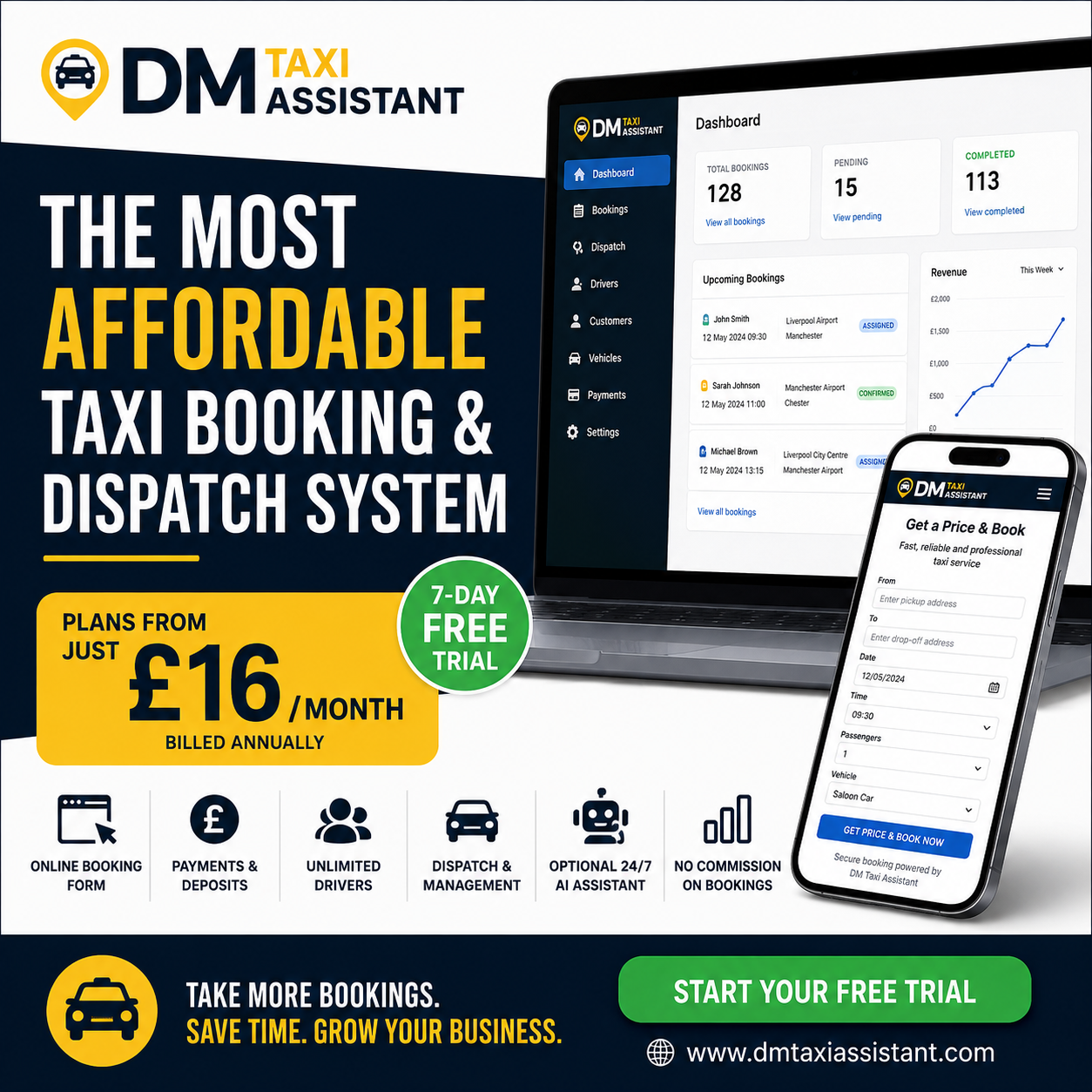
Taxi and private-hire operators looking for an affordable booking and dispatch platform can find out more at DM Taxi Assistant.
It is important to separate two related approvals:
- Uber eligibility: the vehicle must meet the platform’s applicable standards.
- Private-hire vehicle licensing: the car needs a private-hire vehicle licence issued through the relevant licensing system.
GOV.UK advises drivers using a vehicle they do not own to check that it has a vehicle licence. This matters if you plan to rent, lease or use a fleet vehicle. Do not rely on an owner’s verbal assurance: establish that the vehicle is properly licensed for the work you will undertake and that the insurance arrangements cover you.
The supplied guidance does not set out a universal list of eligible models, vehicle ages, emissions standards or local vehicle-test rules. These can vary by city and licensing authority. Check the car before committing to purchase, hire or long-term finance.
6. Documents Uber lists for account activation
Once your licensing and vehicle arrangements are in place, Uber lists the following documents for activation:
- Your private-hire licence paper copy and badge.
- Your DVLA plastic driving licence.
- Your National Insurance number.
- A valid private-hire vehicle insurance certificate.
- A bank statement dated within the previous three months.
The bank statement must relate to the account receiving your Uber payments. It should be in your own name, or in the name of a business you own. Uber says you do not need it for your first Greenlight Hub visit, but you must upload it once you begin earning so that funds can be paid to you.
Document preparation tips
- Check names are consistent across your licence, banking and Uber account records.
- Use a current statement within Uber’s stated three-month window.
- Keep clear digital copies of both sides of physical documents where applicable.
- Check expiry dates before upload, especially for insurance and licences.
- Do not upload a document for a different vehicle or a policy that does not cover private-hire work.
Small discrepancies can cause avoidable delays. Resolve them before booking activation rather than assuming they can be corrected after you are ready to work.
7. Complete Uber’s pre-boarding course and activation
Uber requires drivers to complete its virtual pre-boarding course before activation. Once you have completed it, Uber provides a link to book an appointment at a local Greenlight Hub to activate your account.
Treat this as the final stage of a wider compliance process, not a replacement for licensing. You should have a clear plan for the driver licence, vehicle licence, insurance and document uploads before reaching the appointment stage.
A sensible order for getting started
- Confirm your local licensing route. Establish whether you need to apply through your council, Transport for London or another process in Scotland or Northern Ireland.
- Check your driving-licence position. Ensure you meet local experience rules and, if relevant, convert an EU licence to a UK licence before Uber onboarding.
- Apply for the private-hire driver licence. Complete the authority’s checks, which may include background, medical, knowledge or driving requirements.
- Decide how you will access a vehicle. If using your own car, check local private-hire vehicle licensing and Uber eligibility before committing. If using another person’s or fleet vehicle, verify its licence and insurance position.
- Arrange compliant insurance. Ensure it covers the precise type of private-hire work and meets both authority and Uber requirements.
- Prepare your activation documents. Check your badge, paper licence, DVLA licence, National Insurance number, insurance certificate and recent bank statement.
- Finish Uber’s pre-boarding course. Then use the resulting link to arrange local account activation.
Common mistakes that can delay an Uber application
Applying through the wrong authority
Licensing is local, while platform availability and processes can be city-specific. Confirm that the authority and Uber arrangement are appropriate for where you intend to operate before submitting an application.
Assuming a normal car policy covers ride-hailing
Private-hire driving needs insurance suitable for licensed work. A standard domestic policy is not enough merely because it permits commuting or some business use.
Buying a vehicle before checking both approvals
A car may appear suitable but still fail a local licensing condition or Uber’s standards. Check both before you commit.
Leaving document checks until the end
An expired certificate, an incorrect name, a bank statement outside the permitted date range or a mismatch between vehicle details can hold up activation.
Forgetting renewal obligations
A private-hire driver licence is usually issued for three years. It must be renewed before expiry; otherwise you cannot work. If you already hold a taxi or private-hire licence and are applying for the same type in another area, or if you are renewing, GOV.UK says you must complete an HMRC tax check.
Frequently asked questions
Can I drive for Uber with only a full UK driving licence?
No. A full UK driving licence is one requirement, but you also need a private-hire driver licence from an authority Uber is licensed by. You will also need suitable insurance, the required documents and an eligible vehicle arrangement.
Do I need to own a car before signing up?
No. Uber says you can sign up without currently having an eligible car. However, you will need access to a vehicle that meets Uber’s standards and is properly licensed for private-hire work before carrying passengers.
Can I use an EU driving licence to join Uber in the UK?
Uber says an EU driving licence must be converted to a UK driving licence before onboarding. Deal with this before you expect to activate your Uber account.
Will penalty points prevent me from driving with Uber?
Not necessarily, but the outcome depends on the offence, the licensing authority’s assessment and Uber’s decision. For specified offences, Uber may ask for proof that the authority knows about the endorsement and still considers you fit and proper. Uber retains the final decision on app access.
Is the process the same across the whole UK?
No. England and Wales have the broad route described in GOV.UK guidance, while Scotland and Northern Ireland have different processes. Local authorities and Uber city operations can also impose different requirements.
How often do I need to renew my private-hire driver licence?
It is usually issued for three years, but you must renew before it expires. Your authority may set the precise process and evidence required for renewal, including the HMRC tax-check requirement where applicable.
Final checklist before you apply
- Confirm the correct licensing authority and Uber operating area.
- Check that you meet the age, right-to-work and driving-licence requirements that apply to you.
- Ensure you have, or can obtain, a UK driving licence for Uber onboarding.
- Complete the local private-hire driver licensing process.
- Arrange a compliant, licensed vehicle.
- Obtain private-hire insurance suitable for your location and work.
- Gather your private-hire licence paper copy and badge, DVLA plastic licence, National Insurance number, insurance certificate and recent bank statement.
- Complete the virtual pre-boarding course and book activation when Uber invites you to do so.
Requirements can change by city, authority and platform process. Check the current rules with your licensing authority and Uber before applying, renewing insurance or committing to a vehicle.
Related DM News
- Private Hire Driver Licence Guide UK: Requirements, DBS, Medicals & Council Rules
- Electric Cars for Taxi & Private Hire Drivers UK: Range, Charging, Costs & What to Check
- Uber Announces Electric-Ride Features and Driver Charging Support
Thanks for visiting DM News! If you’ve got a question, a story tip, or anything you’d like to share, head over to DriverMatty.com — I love to hear from you. While you’re there, don’t forget to check out my other websites and social media channels.




