

Starting your own taxi or private hire business can mean anything from becoming a one-car owner-driver to building a local private hire company, airport-transfer operation, chauffeur service or larger fleet.
The opportunity is attractive because you are no longer relying entirely on another company or ride-hailing app to supply your work. You can begin building your own customers, reviews, website, Google presence and repeat bookings.
But there is considerably more involved than buying a car and creating a Facebook page.
Taxi and private hire businesses are regulated, and the licensing route depends on what type of service you intend to provide and where in the UK you operate.
This guide takes you through the main steps involved in starting a taxi or private hire business, from licensing and insurance to pricing, websites, booking software, drivers and getting your first customers.
If you are still trying to get licensed personally, start with our How to Become a Private Hire Driver in the UK guide.
If you already drive professionally and want to begin accepting your own private hire bookings, read our How to Become a Private Hire Operator in the UK guide as well.
Taxi or private hire: decide which business you are starting
The first decision is whether you are building a taxi business, a private hire business or a business that operates within both parts of the industry where local licensing rules allow it.
The words are often used interchangeably by passengers, but legally they are not necessarily the same thing.
Taxi or Hackney carriage
A licensed taxi, often called a Hackney carriage, can generally be hired from a taxi rank or hailed in the street in the area where it is licensed.
Local licensing authorities set the rules covering drivers, vehicles, fares, ranks and other requirements.
Private hire
A private hire vehicle cannot simply pick up someone who waves it down.
Private hire journeys must be booked in advance through the appropriate licensed private hire operator.
Private hire businesses include:
- minicab companies
- airport-transfer businesses
- chauffeur companies
- executive travel businesses
- Uber and other ride-hailing operations
- school and contract transport
- long-distance transfer companies
If your plan is to advertise a service and accept advance private hire bookings yourself, operator licensing is one of the first things you need to investigate.
Step 1: Decide what type of work you want
Do not begin by choosing a car.
Begin by choosing the type of customer and work you want.
Possible business models include:
- local taxi work
- local private hire
- airport transfers
- chauffeur services
- executive travel
- business accounts
- wedding transport
- event transport
- cruise transfers
- school transport
- contract work
- long-distance transfers
- app-based work
- a mixture of several services
This decision affects almost everything else.
A local private hire company doing £8 journeys around town has very different pricing, vehicle and dispatch requirements from an airport-transfer company completing £150 journeys across the country.
Likewise, a chauffeur company targeting corporate customers may invest more heavily in executive vehicles, presentation and business accounts.
Choose your target market before spending heavily.
Step 2: Check your licensing requirements
Taxi and private hire licensing varies across the UK.
In England and Wales, licensing is generally handled by local authorities, with Transport for London responsible for London.
Scotland and Northern Ireland operate under different licensing frameworks.
Do not rely entirely on advice from another driver because their licensing authority may have different rules.
Before spending money, check:
- driver licensing
- vehicle licensing
- private hire operator licensing
- operating-base requirements
- vehicle age limits
- emissions rules
- medical requirements
- DBS or disclosure checks
- training
- knowledge tests
- safeguarding requirements
- vehicle testing
- signage and plates
- insurance requirements
Starting a private hire company
If you intend to accept private hire bookings in England or Wales, you generally need a private hire operator licence.
For private hire operations, the driver, vehicle and operator licensing arrangements need to fit the licensing framework that applies to the authority concerned.
Read our full private hire operator guide before accepting direct private hire bookings.
Starting a Hackney carriage or taxi business
Hackney carriage licensing is different.
Taxis can generally ply for hire, use authorised taxi ranks and accept street hails within the rules applying to their licensed area.
Your local authority may control matters including:
- taxi vehicle specifications
- quantity restrictions where applicable
- rank access
- fares
- meters
- vehicle appearance
- accessibility
- driver licensing
If you intend to combine taxi work with advance bookings, check exactly what licensing arrangements your authority requires.
Step 3: Choose your business structure
A small operator may begin as a sole trader, while others choose to create a limited company.
Sole trader
Operating as a sole trader is usually relatively straightforward.
You run the business personally and report your business income and allowable expenses through Self Assessment where required.
HMRC currently requires registration as a sole trader for Self Assessment where your self-employed earnings exceed the relevant trading allowance, currently £1,000 in a tax year.
Limited company
A limited company is a separate legal entity.
You register the company with Companies House and have additional company, accounting and tax responsibilities.
Some taxi and private hire operators prefer a limited company structure as the business grows, particularly where several people, vehicles or contracts are involved.
Neither structure is automatically right for every operator.
If you are unsure, speak with an accountant before deciding.
Step 4: Choose a strong business name
Your business name matters more than many new operators realise.
It will potentially appear on:
- your website
- invoices
- booking confirmations
- vehicles
- social media
- emails
- customer reviews
- business cards
- licensing documents
Choose something memorable, professional and easy to spell.
Before committing to it, check:
- Companies House
- available domain names
- social-media usernames
- UK trade marks where appropriate
- similarly named taxi businesses in your area
Avoid choosing a name that makes customers think you are another established company.
If you intend to grow beyond your home town, think carefully before making the business name excessively local.
Step 5: Choose the right vehicle
Your vehicle is one of the largest investments in the business.
Before buying anything, check the licensing standards of the authority you plan to use.
Vehicle rules can cover:
- maximum age
- emissions
- passenger capacity
- number of doors
- vehicle condition
- accessibility
- colour
- signage
- licence plates
- MOT and additional inspections
- window tint
- CCTV
- tyres
- taximeters
Do not buy a car specifically for taxi or private hire use until you know it can actually be licensed.
Think about the work as well as licensing
A vehicle can meet licensing rules and still be wrong for your business.
For example:
Local private hire: fuel economy and reliability may matter most.
Airport transfers: luggage space becomes extremely important.
Executive travel: passenger comfort and presentation may matter more.
Large groups: you may need appropriately licensed MPVs or minibuses depending on passenger capacity and the licensing regime.
Electric vehicles: charging availability, home charging and daily mileage become important.
Calculate the full operating cost rather than simply comparing purchase prices.
Step 6: Arrange the correct insurance
Ordinary personal car insurance is not sufficient for carrying passengers for payment.
You need appropriate insurance covering the work being undertaken, commonly referred to as taxi insurance, private hire insurance or hire-and-reward insurance.
The exact cover you require depends on the business.
You may also need to consider:
- public liability insurance
- office insurance
- breakdown cover
- legal expenses cover
- employers’ liability insurance if you employ staff
- cover for additional drivers
Never assume a policy covers a particular type of work.
Tell the insurer exactly how the vehicle and business will operate.
Step 7: Work out your real costs
A common mistake is setting prices based on what competitors charge rather than what the journey actually costs your business.
Your costs may include:
- vehicle finance
- depreciation
- insurance
- fuel
- electricity
- servicing
- tyres
- repairs
- cleaning
- vehicle licensing
- driver licensing
- operator licensing
- parking
- airport charges
- card fees
- booking software
- phone
- accounting
- website
- advertising
- tax
Then consider your time.
If a £60 airport journey takes 90 minutes but you then drive another 90 minutes home empty, it is not simply a 90-minute £60 job.
Empty mileage can destroy the profitability of long-distance work if you ignore it.
Step 8: Set your fares
Once you understand your costs, create a pricing structure.
Depending on your operation, you might use:
- price per mile
- distance bands
- minimum fares
- fixed airport prices
- fixed local routes
- zones
- hourly hire
- waiting charges
- night rates
- peak rates
- meet-and-greet fees
- parking charges
- additional-stop charges
- different rates by vehicle type
Your prices should be easy for both your customers and your booking system to understand.
Do not create a pricing model so complicated that you cannot quote consistently.
Taxi fares can be regulated by local authorities in circumstances where Hackney carriage fare controls apply, so check the rules applying to your licence.
Step 9: Set up your booking and dispatch system
Once you begin getting direct customers, you need somewhere reliable to keep the bookings.
Trying to run a growing taxi company entirely from WhatsApp messages, text messages and a paper diary quickly becomes difficult.
You need to know:
- who the passenger is
- their telephone number
- pickup
- destination
- date
- time
- passengers
- luggage
- vehicle requested
- quoted fare
- deposit or payment status
- allocated driver
- special instructions
- flight details where relevant
- booking changes
That is where a proper booking and dispatch system becomes valuable.
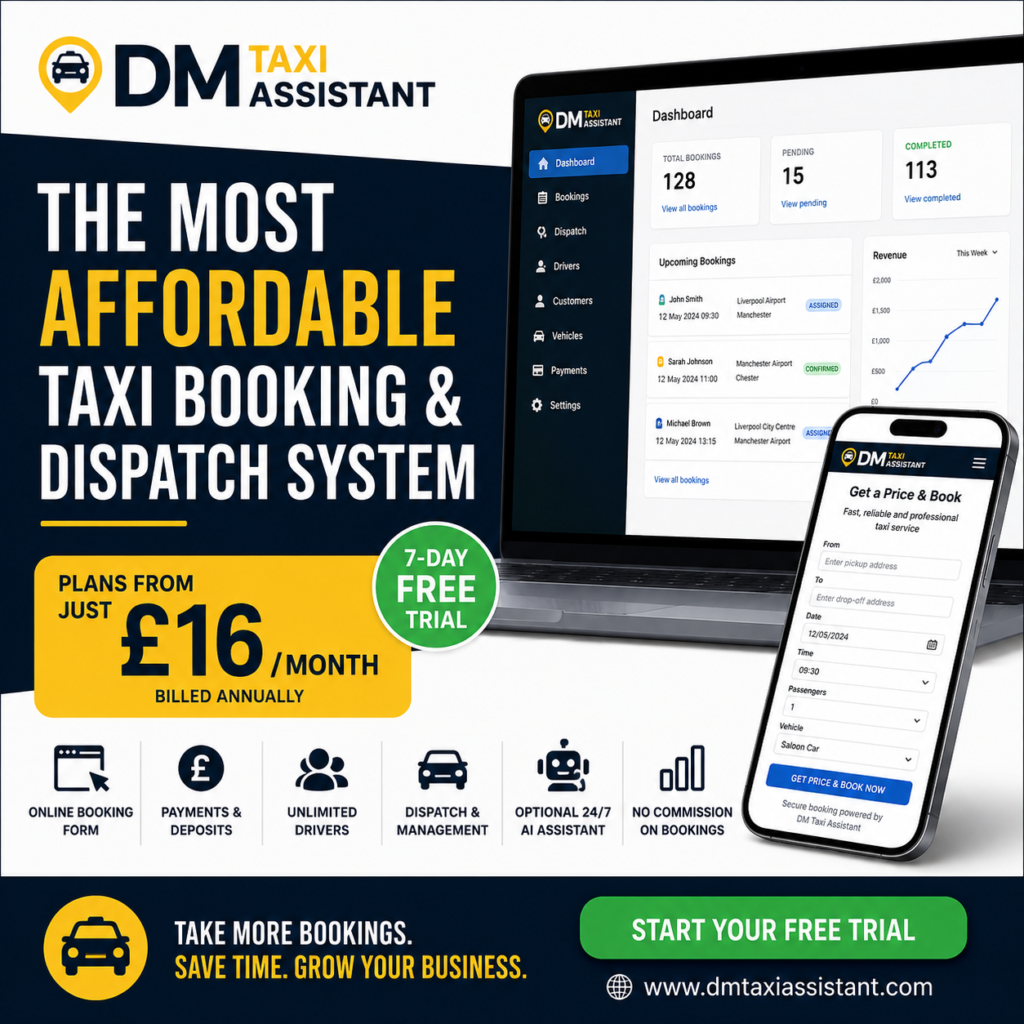
DM Taxi Assistant
DM Taxi Assistant is designed for taxi, private hire, chauffeur and airport-transfer companies.
The booking and dispatch system currently starts from £16 per month when paid annually and includes unlimited bookings and unlimited drivers.
Operators can use it to:
- put a booking form on their website
- provide instant prices from their own tariff
- take online card payments or allow payment on the day
- keep bookings in one dashboard
- allocate work to drivers
- calculate agreed driver percentages
- send booking details to drivers
- manage customer and journey information
Operators can also add the optional AI assistant, which can answer common customer questions, quote journeys using the operator’s own pricing and turn conversations into bookings or enquiries.
The system does not decide what you should charge.
You set your prices and rules.
DM Taxi Assistant currently offers a 7-day free trial, allowing a new business to build and test its booking setup before committing.
You also do not need an existing website to use it because a hosted booking page can be provided.
The software does not replace any licence or permission legally required to accept bookings.
Step 10: Build a website
If you want customers to book your business directly, having your own website is one of the most useful things you can build.
Your website should clearly explain:
- who you are
- where you operate
- services provided
- vehicles
- how to get a quote
- how to book
- contact details
- terms
- privacy information
- frequently asked questions
More importantly, a good website gives Google pages that can potentially appear when customers search for the journeys you provide.
For example, an airport-transfer company may eventually create useful pages targeting searches such as:
- Liverpool to Manchester Airport taxi
- Birmingham Airport transfers
- Manchester to Heathrow transfer
- airport taxi near me
- 8 seater airport transfer
- executive airport transfer
The aim is to create useful pages matching genuine customer searches rather than stuffing dozens of place names onto one page.
Starting without a website?
If you need one, DM Site Builder allows businesses to create a free professional website.
It can be used by taxi, private hire, airport-transfer and chauffeur businesses and is designed to give small businesses an online presence without paying a web designer before the business has begun producing regular bookings.
If you use DM Taxi Assistant, the booking system can then be connected to your website.
That gives you the two important parts:
DM Site Builder: somewhere customers can find and learn about your business.
DM Taxi Assistant: somewhere customers can quote, book and have their journey managed.

Step 11: Set up payments
Decide how customers will pay before taking bookings.
Options include:
- cash
- card in the vehicle
- online card payment
- deposit when booking
- full payment when booking
- bank transfer
- business account
- monthly invoicing
Airport and long-distance businesses may find deposits particularly useful because they reduce the financial impact of late cancellations and no-shows.
Whatever payment method you choose, make it clear to the passenger before confirming the booking.
Step 12: Create proper terms and policies
Do not wait until your first dispute before deciding your rules.
Your booking terms should consider areas such as:
- cancellations
- refunds
- deposits
- no-shows
- waiting time
- airport delays
- flight changes
- additional stops
- luggage
- passenger numbers
- child seats
- vehicle substitutions
- customer damage or soiling
- payment
- late customers
Terms must still comply with applicable consumer law.
You should also have appropriate privacy information explaining how customer data is used.
Step 13: Deal with data protection
Taxi businesses collect a surprising amount of personal information.
A booking may contain:
- passenger name
- telephone number
- home address
- destination
- flight number
- travel dates
- payment information
- notes about the passenger
You need to handle that information responsibly.
The Information Commissioner’s Office provides guidance for small businesses on privacy notices and whether they need to pay the data-protection fee.
Many businesses processing personal information need to pay the fee unless an exemption applies.
Do not simply copy another company’s privacy policy.
Your privacy information should explain what your own business actually does with customer data.
Step 14: Understand tax and accounts
Keep proper financial records from the beginning.
Record:
- fares received
- card payments
- cash
- deposits
- driver payments
- fuel
- charging
- insurance
- vehicle costs
- repairs
- licence fees
- airport fees
- software
- marketing
- other business expenses
The tax system applying to you depends partly on your business structure.
A sole trader and a limited company are not taxed in exactly the same way.
VAT
At the time of writing, compulsory UK VAT registration generally applies once taxable turnover exceeds £90,000 over the relevant period, subject to the detailed HMRC rules.
You can also register voluntarily below the threshold.
VAT can have a significant effect on taxi and private hire pricing, so do not wait until the business is close to the threshold before understanding it.
An accountant familiar with taxi or transport businesses can be extremely useful as the business grows.
Step 15: Get your business on Google
Once the legal and operational side is ready, you need customers.
For many local taxi and private hire firms, Google is one of the most important places to be visible.
Consider setting up and properly maintaining a Google Business Profile where your business is eligible.
Your website should also contain genuinely useful information about the services and locations you cover.
Do not try to rank for the entire UK on your first day.
Start with the work you actually want.
For example:
- your town
- nearby towns
- local airports
- popular long-distance destinations
- executive travel
- group transfers
Then expand as the business grows.
Step 16: Start collecting genuine reviews
Reviews are particularly important in passenger transport because customers are placing trust in the business and driver.
Make asking for a review part of your normal process.
The ideal time is shortly after a successful journey.
You might send a simple text, WhatsApp message or email thanking the customer and providing a direct review link.
Never buy reviews or create fake customer accounts.
Ten genuine reviews from real passengers are more valuable to your business than hundreds of suspicious ones that damage trust.
Step 17: Build repeat business
A business becomes much stronger when every week’s revenue does not depend entirely on finding new customers.
Keep providing a good service and give passengers a reason to use you again.
Repeat customers can include:
- holidaymakers
- business travellers
- corporate accounts
- hotels
- wedding venues
- travel agents
- universities
- local businesses
- families
- regular airport passengers
Make rebooking easy.
Your website, booking system, telephone number and branding should all help customers find you again.
Step 18: Add drivers carefully
Eventually you may receive more work than one driver can complete.
That is a good problem, but it introduces additional responsibilities.
Before allocating bookings to another driver, check that the arrangement is lawful and compatible with your operator licence and licensing conditions.
You need processes for checking relevant:
- driver licences
- vehicle licences
- insurance
- expiry dates
- contact details
- vehicle details
You also need to decide how drivers will be paid.
Possible arrangements include:
- fixed amount per journey
- percentage
- commission
- vehicle rental
- employment
Employment status cannot simply be changed by calling somebody self-employed. The actual working relationship matters.
If you employ staff, additional responsibilities can arise, including PAYE, workplace duties and employers’ liability insurance.
In Great Britain, most employers who are required to have employers’ liability insurance need at least £5 million of cover.
Take professional advice where needed.
Can you start a taxi business with one car?
Yes.
You do not need to begin with an office and 20 vehicles.
A one-person owner-driver business can be an excellent way to start because it allows you to learn:
- which work is profitable
- which areas generate bookings
- which customers return
- what your true costs are
- what your vehicle can realistically complete
- how much time administration takes
You can then expand when the bookings justify it rather than adding unnecessary costs on day one.
Can you run a private hire company from home?
Potentially, but do not assume the answer is automatically yes.
You need to check:
- licensing-authority requirements
- planning requirements
- tenancy or mortgage conditions
- restrictions on visitors or staff
- insurance
Some councils permit certain home-based operations while others may impose additional requirements.
TfL, for example, requires London private hire operators to have an approved operating centre and evidence relating to its lawful planning use.
Check your own authority before applying.
How much does it cost to start a taxi business?
There is no useful single figure because two businesses can be completely different.
A driver who already owns an eligible vehicle and works from home will have very different startup costs from somebody buying an executive vehicle and renting an office.
Budget for possible costs including:
- driver licence
- operator licence
- vehicle licence
- DBS checks
- medical
- vehicle
- deposit or finance
- insurance
- vehicle inspection
- servicing
- tyres
- fuel or charging
- website
- booking software
- phone
- payment processing
- accounting
- advertising
- working capital
You should also keep money available for unexpected repairs.
A vehicle off the road is not just a repair bill — it can also mean lost income.
Is an airport-transfer business a good way to start?
Airport transfers can work particularly well for owner-drivers because the average booking value can be considerably higher than short local work.
However, airport transfers introduce additional considerations:
- airport pickup charges
- airport drop-off fees
- parking
- flight delays
- flight tracking
- meet and greet
- luggage capacity
- long-distance empty mileage
- early morning and overnight journeys
- cancellations
- drivers covering bookings when you are unavailable
A reliable booking system becomes increasingly important because many airport bookings are made weeks or months in advance.
Should you rely entirely on Uber or other apps?
Ride-hailing platforms can be a useful source of work, particularly for new drivers.
But there is a fundamental difference between working through somebody else’s platform and building your own business.
A platform controls the customer relationship.
Your own direct-booking business allows you to build:
- your own name
- your own reviews
- your own repeat customers
- your own website
- your own pricing strategy
- your own customer database, subject to data-protection law
Many drivers may choose to do both while their direct customer base grows.
The basic taxi business setup
A simple owner-driver private hire business could eventually look like this:
Customer searches Google
↓
Customer finds your website
↓
Customer checks a price or sends a booking
↓
DM Taxi Assistant records the booking
↓
Customer pays a deposit or chooses payment on the day
↓
You allocate the journey to yourself or another licensed driver
↓
The driver completes the journey
↓
Customer receives good service
↓
You ask for a genuine review
↓
Customer books directly again next time
That is how an individual driving job gradually turns into a business with its own customers and value.
Taxi and private hire business startup checklist
Before launching:
- Decide whether you are operating taxi, private hire or another licensed model
- Choose the work you want to target
- Identify the correct licensing authority
- Obtain the required driver licence
- Obtain the appropriate vehicle licence
- Obtain an operator licence where required
- Check operating-base requirements
- Choose your business structure
- Choose your business name
- Check Companies House and domain availability
- Arrange suitable insurance
- Work out your operating costs
- Set profitable fares
- Create booking terms
- Create appropriate privacy information
- Check your data-protection obligations
- Open appropriate financial accounts
- Set up bookkeeping
- Understand your tax responsibilities
- Check VAT requirements
- Build your website
- Set up online bookings
- Set up a dispatch system
- Set up payments
- Create a Google presence
- Start collecting genuine reviews
- Keep records of licence and insurance expiry dates
- Create a process for adding drivers as you grow
What should you read next?
If you are still at the beginning of the process, our two existing guides explain the licensing journey in more detail:
How to Become a Private Hire Driver in the UK
How to Become a Private Hire Operator in the UK
We will also be publishing dedicated guides covering becoming a Hackney carriage driver, starting an airport-transfer business, taxi websites, taxi pricing and getting more direct taxi bookings.
If you are ready to start building the business side, DM Taxi Assistant can provide the booking, pricing and dispatch system, while DM Site Builder can provide a free website if you do not already have one.
The goal is not simply to become another driver.
It is to build a business customers can find, book and come back to.
Thanks for visiting DM News! If you’ve got a question, a story tip, or anything you’d like to share, head over to DriverMatty.com� — I love to hear from you. While you’re there, don’t forget to check out my other websites and social media channels.
Sources
Operator licences for private hire vehicles — GOV.UK
Vehicle licences for taxis or private hire vehicles — GOV.UK
Vehicle licence eligibility and insurance — GOV.UK
Statutory Taxi and Private Hire Vehicle Standards — Department for Transport
Register as a sole trader — GOV.UK
Set up a limited company — GOV.UK
Employers’ Liability Insurance — GOV.UK
Apply for a Private Hire Operator Licence — Transport for London
Data Protection Fee — Information Commissioner’s Office
Privacy Notices and Cookies — Information Commissioner’s Office




