
Becoming a private hire operator is the point where you move from simply driving passengers to running the business that accepts and manages private hire bookings.
You could start with one car and drive every journey yourself, build an airport-transfer or chauffeur business, operate a traditional local minicab company or eventually manage a fleet of drivers.
But accepting private hire bookings is a regulated activity. Having a private hire driver licence does not automatically allow you to start taking your own bookings.
In England and Wales, anyone accepting private hire vehicle bookings generally needs an appropriate private hire operator licence. London is licensed by Transport for London, while Scotland and Northern Ireland operate under different systems.
If you are still at the driver-licensing stage, read our How to Become a Private Hire Driver in the UK guide first.
This guide explains what you need to consider before starting your own operation, including licensing, vehicles, drivers, booking records, websites, pricing, customer data and booking and dispatch software.
What is a private hire operator?
A private hire operator is the person or business responsible for accepting private hire bookings and arranging for licensed vehicles and drivers to carry out those journeys.
That distinction is important.
A private hire driver may drive passengers for a licensed operator, but that does not necessarily mean the driver can independently accept private hire bookings from members of the public.
The operator sits between the passenger and the driver.
The operator may:
- advertise the service
- receive enquiries
- quote prices
- accept bookings
- record passenger and journey information
- allocate journeys to drivers
- take deposits or payments
- deal with changes and cancellations
- maintain booking records
- manage customer complaints
A private hire operator does not have to be a large taxi company.
A one-person airport-transfer business, chauffeur business or owner-driver accepting direct bookings may still require the appropriate operator licence.
Step 1: Understand which licensing system applies to you
There is not one identical private hire operator licensing system covering the whole UK.
England and Wales
In England and Wales, private hire operators generally need an operator licence from the licensing authority responsible for the area in which the business operates.
Outside London this is normally a local council.
Private hire vehicles can only carry journeys that have been booked in advance through the appropriate licensed operator.
Operator licences can be issued for up to five years, although individual licensing authorities determine their own application procedures, conditions and fees.
London
Private hire operators in London are licensed by Transport for London.
TfL has detailed requirements covering operating centres, record keeping, booking and dispatch staff, licensing fees and how operators contract with passengers.
Even a one-person chauffeur or private hire operation can fall within the operator-licensing regime.
Scotland
Scotland has a different system.
The use of certain premises for taking bookings for taxis or private hire cars can require a booking office licence. Scottish rules and thresholds differ from the operator-licensing system used in England and Wales.
Check the requirements of the relevant Scottish licensing authority before accepting bookings.
Northern Ireland
Northern Ireland uses its own taxi operator licensing system administered through the Driver & Vehicle Agency.
Operators can apply under different categories depending on the size of their operation.
The rest of this guide concentrates mainly on the England and Wales private hire operator model, although many of the business principles apply throughout the UK.
Step 2: Decide what type of private hire business you are building
Before applying for anything, work out exactly what you want the business to do.
Examples include:
- local private hire
- airport transfers
- chauffeur services
- executive travel
- corporate accounts
- school transport
- contract work
- long-distance transfers
- event transport
- app or platform-based bookings
Your intended operation can affect your vehicle requirements, insurance, operating address, licensing costs and the technology you need.
Starting with a clear business model also makes pricing much easier.
A local minicab firm completing dozens of short journeys has very different requirements from a one-car airport-transfer company doing six long-distance bookings per week.
Step 3: Choose your operating area and licensing authority
Do this before spending heavily on branding, premises or vehicles.
Licensing authorities can impose different conditions.
Check:
- operator application requirements
- application fees
- licence duration
- operating-base requirements
- planning requirements
- criminal-record checks
- right-to-work or immigration checks where relevant
- record-keeping requirements
- driver requirements
- vehicle requirements
- staff requirements
- complaint procedures
- safeguarding policies
Do not assume the rules of another council apply to you.
This is especially important when you see another private hire business operating differently online.
Their licensing authority, business structure and licence conditions may be different from yours.
Step 4: Decide who will hold the operator licence
A private hire business could operate as a sole trader, partnership or limited company.
Whichever structure you choose, make sure the operator-licence application correctly reflects the person or legal entity that will actually operate the business.
Licensing authorities may carry out suitability checks on applicants, directors, partners or other people involved in the operation.
Being granted an operator licence is not simply a matter of paying a fee.
Authorities need to be satisfied that the applicant meets the relevant licensing criteria and can operate the business appropriately.
If you plan to form a limited company, open business bank accounts, register a trading name or take on partners, it is sensible to decide the structure before completing the operator application rather than attempting to change everything afterwards.
Step 5: Choose your operating base
Some authorities require details of the address from which your private hire operation will be run.
That could potentially be:
- your home
- an office
- a taxi base
- a commercial unit
Whether a home address is suitable depends on the licensing authority, planning rules, tenancy or mortgage restrictions and how the premises will actually be used.
Do not automatically sign a commercial lease because you assume a taxi operator needs a high-street office.
Equally, do not assume you can run the operation from home without checking.
London operators, for example, need at least one operating centre in London and TfL requires evidence relating to planning permission or lawful use for proposed operating centres.
Check first.
Step 6: Apply for the operator licence
The exact application process depends on the authority.
You may be asked for information covering:
- business ownership
- directors or partners
- operating address
- criminal-record information
- previous licensing history
- right to work or immigration status where applicable
- business structure
- proposed number of vehicles
- booking arrangements
- record-keeping systems
- safeguarding
- complaints handling
- staff
- planning permission
- application fees
Some applications are straightforward. Others can take months.
Do not advertise yourself as a licensed private hire operator or start accepting journeys requiring an operator licence before the necessary licence has actually been granted.
Step 7: Make sure your drivers and vehicles are correctly licensed
An operator licence does not replace driver and vehicle licensing.
You need to make sure the drivers and vehicles undertaking private hire work meet the licensing requirements that apply to the operation.
A private hire business therefore normally involves three separate areas:
Operator licence – allows the operator to accept and manage private hire bookings.
Driver licence – allows the licensed driver to drive private hire passengers.
Vehicle licence – allows the vehicle to be used as a licensed private hire vehicle.
You also need appropriate hire-and-reward motor insurance for vehicles carrying paying passengers.
Never assume somebody is suitable to complete work simply because they have a normal UK driving licence and insured car.
Step 8: Set up your booking system
Once you start accepting direct bookings, organisation quickly becomes one of the biggest differences between being a driver and being an operator.
Even a one-car operation needs a reliable way of recording:
- passenger name
- contact details
- pickup address
- destination
- date
- pickup time
- fare or pricing arrangement
- driver
- vehicle
- booking changes
- cancellations
- payment status
- relevant customer instructions
The Department for Transport’s statutory standards recommend detailed private hire booking records and suggest that records should generally be retained for a minimum of six months, although your actual licensing authority may impose its own conditions or longer requirements.
This is where using proper taxi booking software becomes significantly easier than managing everything through text messages, WhatsApp conversations and scraps of paper.
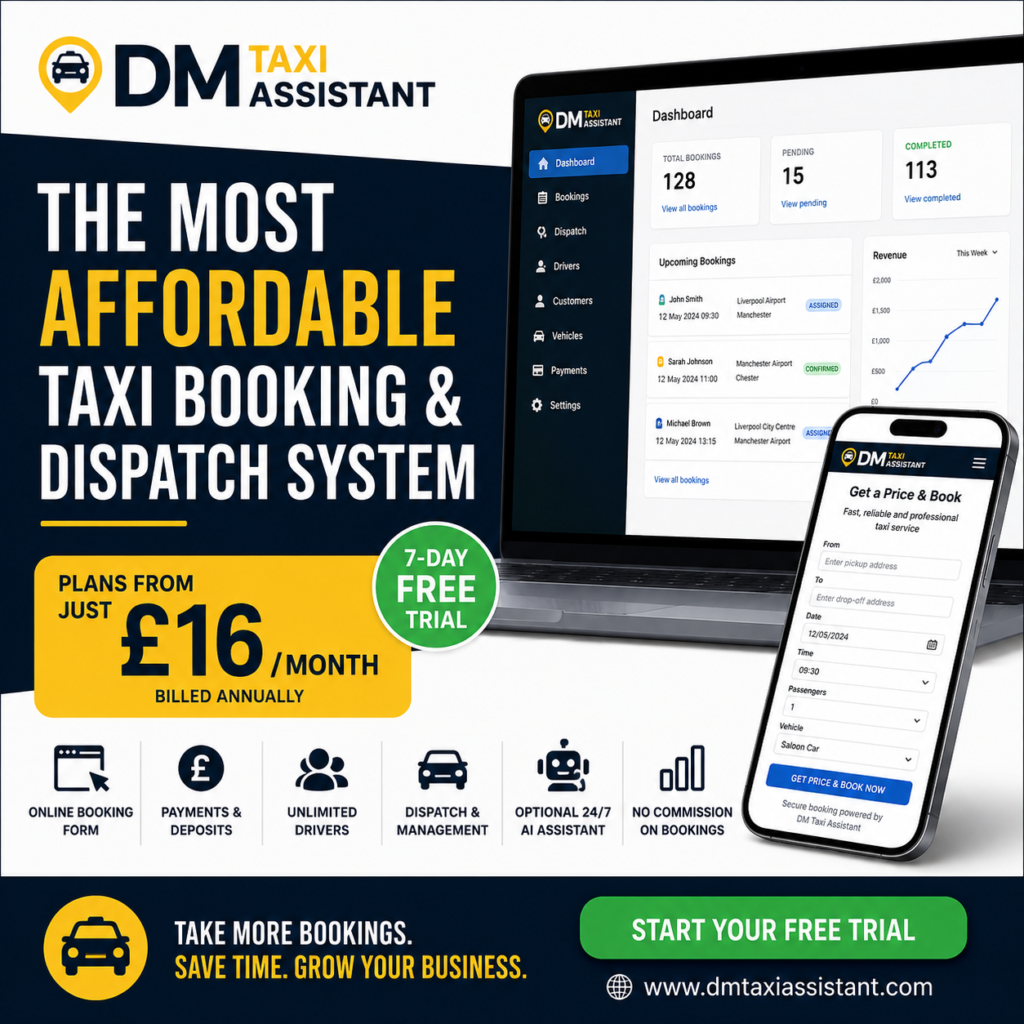
DM Taxi Assistant
DM Taxi Assistant is built specifically for taxi, private hire, chauffeur and airport-transfer businesses.
It can provide operators with:
- a customer booking form
- an AI booking assistant
- automatic quotes based on your own pricing
- enquiry capture
- deposits and online payments
- booking management
- driver allocation
- driver-dispatch tools
- an operator portal
- customer booking information in one place
The system uses the operator’s own fares and rules rather than creating its own prices.
For a new operator, this can mean starting with a system designed to handle bookings properly rather than trying to rebuild your processes after the business becomes busy.
DM Taxi Assistant currently offers a free trial, so operators can set up the system and test how it works before committing to it.
Software does not make an unlicensed business legal. You still need all licences and permissions required for your operation.
Step 9: Decide how you will calculate fares
Pricing is one of the biggest decisions a new operator makes.
Charging too much can make it difficult to win work.
Charging too little can create a busy business that makes very little profit.
Consider:
- minimum fares
- price per mile
- price per minute or waiting time
- airport pickup fees
- airport drop-off charges
- meet-and-greet charges
- parking
- late-night rates
- peak rates
- additional stops
- larger vehicles
- executive vehicles
- child-seat arrangements
- waiting after the booked time
- cancellation charges
- driver payments
- card-processing costs
Airport and long-distance operators should be particularly careful about calculating empty mileage.
A £100 journey is not necessarily a profitable £100 booking if the vehicle travels another 100 miles empty to get home.
DM Taxi Assistant allows operators to configure their own pricing, including options such as mileage-based pricing, fixed journeys, zones and additional pricing rules.
Step 10: Create clear booking terms
Passengers should know what they are agreeing to.
Consider having written terms dealing with:
- cancellations
- refunds
- deposits
- waiting time
- no-shows
- airport delays
- additional stops
- changes to the booking
- luggage
- passenger numbers
- vehicle substitutions
- soiling or damage
- payment
- child seats
- meet-and-greet arrangements
Your terms must still comply with applicable consumer law.
Do not use terms simply because another taxi company has them on its website.
Make sure they reflect the service you actually provide.
Step 11: Build a website
A private hire operator can survive entirely on app work, subcontracting or existing contracts, but if you want direct customers, a website is one of the most useful assets you can build.
Your website gives potential customers somewhere to:
- understand your service
- see the areas you cover
- request a quote
- make a booking
- read your terms
- view your contact details
- find answers to common questions
- see customer reviews
- discover your business through Google
It also helps reduce dependence on third-party booking platforms.
A local private hire operator might target searches around its town.
An airport-transfer operator can build useful pages around the airports and routes it regularly serves.
A chauffeur company might focus more heavily on executive travel, business accounts and events.
Need a website?
If you are only just starting and do not have a website, DM Site Builder provides a free website option for businesses, including taxi, private hire, chauffeur and airport-transfer operators.
You can then connect your business website to DM Taxi Assistant so customers have somewhere to find you and somewhere to book you.
You do not actually need your own website to start using DM Taxi Assistant because it can also provide a hosted booking page.
That gives a new operator the option of getting the booking system running first and building the wider website around it.

Step 12: Understand your data-protection responsibilities
Taxi and private hire operators handle a significant amount of personal information.
That can include:
- customer names
- phone numbers
- email addresses
- home addresses
- pickup and destination information
- flight details
- booking history
- payment information
- driver information
That information needs to be handled properly.
Businesses processing personal data need to understand their responsibilities under UK data-protection law.
You will normally need an appropriate privacy notice explaining how customer information is used.
Depending on how your business processes personal information, you may also need to register with the Information Commissioner’s Office and pay the relevant data-protection fee unless an exemption applies.
If you use third-party booking, payment, email or dispatch services, understand which businesses are processing customer information and make sure your own privacy information reflects what actually happens.
Step 13: Set up payments
Decide how customers will pay.
Options can include:
- cash
- card in the vehicle
- online card payment
- booking deposit
- full prepayment
- bank transfer
- corporate account invoicing
Different types of work may need different payment methods.
An airport-transfer operator may prefer a deposit when the booking is made.
A corporate chauffeur account may be invoiced monthly.
A local private hire passenger may simply pay the driver after the journey.
Whatever system you choose, make the payment arrangement clear before the journey.
Step 14: Decide how drivers will be paid
If you eventually add drivers, decide how the arrangement works before sending them bookings.
Common models include:
- fixed amount per journey
- percentage of fare
- driver keeps fare and pays operator commission
- vehicle rental
- account or contract arrangements
Employment status and tax treatment can be complicated and depend on the real working relationship rather than simply what the agreement is called.
Take professional accounting or legal advice where necessary.
DM Taxi Assistant can help operators allocate bookings to drivers and calculate a driver’s agreed share of a journey, but the operator remains responsible for setting up lawful commercial arrangements.
Step 15: Prepare for complaints and problems
Every operator eventually deals with a problem.
It might be:
- driver late
- customer late
- flight delayed
- incorrect address
- vehicle breakdown
- customer no-show
- payment dispute
- driver complaint
- lost property
- safeguarding concern
- accident
Your licensing authority may have specific complaint and record-keeping requirements.
Have a process before you need it.
Keep accurate booking records and record serious complaints appropriately.
If an allegation raises an immediate safeguarding, criminal or public-safety concern, it may need to be reported to the appropriate authority rather than treated as an ordinary customer-service complaint.
How much does it cost to become a private hire operator?
There is no single UK-wide figure.
Possible startup costs include:
- operator licence
- DBS or disclosure checks
- operating premises
- planning applications where required
- driver licence
- vehicle licence
- vehicle purchase, finance or rental
- hire-and-reward insurance
- website
- booking software
- card processing
- phone
- accounting
- marketing
- signage
- vehicle testing
A one-car home-based operation can cost considerably less to establish than a staffed office with several vehicles.
London also operates a tiered operator-licensing fee structure based on the size of the operation, so applicants should check current TfL fees directly before applying.
Do I need to be a private hire driver to own a private hire operator?
Do not assume that an operator licence and driver licence are the same thing.
They perform different functions.
Some operators drive their own vehicles, while others concentrate on running the business and dispatching work to licensed drivers.
If you personally intend to drive passengers, you will also need the appropriate driver licence.
Can I start with one car?
Yes.
A private hire operation does not need dozens of vehicles.
Many airport-transfer, chauffeur and local private hire businesses begin as an owner-driver operation.
Starting small can actually make it easier to learn:
- which journeys are profitable
- which areas generate bookings
- what customers ask for
- how long journeys really take
- how much empty mileage costs
- what pricing works
- which marketing produces customers
Once you have more bookings than you can personally complete, you can consider adding drivers or subcontracting work where your licensing conditions and the law allow it.
Can I take bookings through WhatsApp or Facebook?
The method a customer uses to contact you does not remove the licensing requirement.
A booking can begin through a telephone call, website, app, social-media message or messaging service.
What matters is whether you are legally entitled to accept and fulfil that private hire booking.
Social media can be useful for customer communication, but it is not a replacement for proper booking records.
As the business grows, moving confirmed journeys into one central booking system becomes increasingly important.
How do I get customers for a new private hire business?
Getting the operator licence allows you to operate.
It does not automatically bring customers.
A new business should consider:
- Google Business Profile
- a good website
- local SEO
- airport and destination pages
- customer reviews
- business accounts
- hotels
- travel agents
- wedding venues
- social media
- repeat-customer marketing
- referral business
- clear online booking
The long-term aim is to create a business people search for by name rather than having to buy every customer through another platform.
That takes time, but every direct customer and genuine review contributes to building your own brand.
Private hire operator startup checklist
Before accepting your first direct booking:
- Choose the type of private hire business
- Identify the correct licensing authority
- Read the current operator-licensing policy
- Choose the correct business structure
- Confirm your operating-base requirements
- Apply for the operator licence
- Make sure all drivers are correctly licensed
- Make sure all vehicles are correctly licensed
- Arrange appropriate insurance
- Create a booking-record system
- Set your prices
- Set your booking terms
- Set up payments
- Create your privacy notice
- Check whether ICO registration and a data-protection fee apply
- Build your website
- Set up online enquiries and bookings
- Set up driver dispatch
- Create a complaints process
- Start building reviews and Google visibility
- Keep track of every licence and renewal date
What should you read next?
If you already have your private hire driver licence and are now considering an operator licence, you are moving from simply earning money from journeys to building a business that can generate bookings of its own.
The next cornerstone guide will be:
How to Start a Taxi or Private Hire Business in the UK
That guide will bring everything together — licensing, business setup, vehicles, pricing, websites, Google, booking systems, marketing, drivers and how to grow from an owner-driver into a larger operation.
For operators who are ready to put the booking side in place now, DM Taxi Assistant can handle customer enquiries, quotes, bookings, deposits and driver dispatch from one system, while DM Site Builder can provide a free website if you are starting without one.
Thanks for visiting DM News! If you’ve got a question, a story tip, or anything you’d like to share, head over to DriverMatty.com� — I love to hear from you. While you’re there, don’t forget to check out my other websites and social media channels.
Sources
Operator licences for private hire vehicles — GOV.UK
Statutory Taxi and Private Hire Vehicle Standards — Department for Transport
Taxi and Private Hire Vehicle Licensing Best Practice Guidance — Department for Transport
Private Hire Operator Licence — Transport for London
Taxi and Private Hire Car Licensing: Licensing of Booking Offices — Scottish Government
Apply for a Taxi Operator Licence — nidirect
Complete a Tax Check for a Taxi or Private Hire Licence — HMRC
Data Protection Fee — Information Commissioner’s Office
Privacy Notices and Cookies — Information Commissioner’s Office




