
Becoming a private hire driver can be one of the quickest ways to enter the professional driving industry in the UK, whether you want to drive for an app such as Uber, work with a local private hire company, specialise in airport transfers or eventually build your own private hire business.
However, you cannot simply insure your car, download a driver app and start carrying paying passengers.
Private hire driving is a licensed activity. You normally need an appropriate driver licence, a properly licensed vehicle and hire-and-reward insurance, and every private hire journey must be booked through a licensed private hire operator or equivalent licensing arrangement for the part of the UK where you work.
This guide explains the process, the main costs and checks you should expect and what you should consider if your long-term aim is to build your own customer base rather than relying entirely on third-party apps.
What is a private hire driver?
A private hire driver carries passengers in a licensed private hire vehicle, often shortened to PHV.
Private hire vehicles must be booked in advance.
That is one of the biggest differences between private hire vehicles and traditional taxis or Hackney carriages. A licensed taxi may generally be able to pick passengers up from a taxi rank or accept a street hail where permitted. A private hire driver cannot simply pick up somebody who flags them down.
Private hire work can include:
- Uber, Bolt and other ride-hailing work
- local minicab companies
- airport transfers
- executive and chauffeur work
- school contracts
- corporate transport
- event transfers
- long-distance private hire
- pre-booked local journeys
The licensing arrangements depend on where you are based.
England and Wales largely operate through local licensing authorities, with Transport for London responsible for London. Scotland and Northern Ireland operate under different licensing systems.
Step 1: Decide where you want to be licensed
Before spending money on a vehicle, insurance or an application, decide which licensing authority you intend to apply to.
Outside London, this will normally be a local council or licensing authority.
In London, private hire driver licensing is handled by Transport for London.
This matters because there is no single identical application process used by every licensing authority.
Requirements can differ on issues such as:
- minimum age
- how long you must have held a driving licence
- medical standards
- driving assessments
- local knowledge tests
- safeguarding training
- disability awareness training
- English-language requirements
- licence fees
- vehicle age limits
- emissions standards
- vehicle testing
Always read the current requirements of the authority you are applying to before paying for anything.
What about the new national taxi and private hire standards?
The English Devolution and Community Empowerment Act 2026 gives the Government powers to introduce national standards for taxi and private hire licensing in England.
However, that does not mean every council currently operates exactly the same licensing process.
At the time of writing, applicants should continue following the requirements published by the licensing authority they are applying to. Any future national standards will need to be reflected in this guide as they are brought into force.
Step 2: Make sure you have the correct driving licence
You will need a full driving licence that meets the requirements of your chosen licensing authority.
Some authorities require applicants to have held their full driving licence for a minimum period before applying.
Do not assume the requirement is identical everywhere.
London, for example, currently requires private hire driver applicants to be at least 21 and generally to have held an eligible full driving licence for at least three years.
Other authorities may use different criteria.
Check this before starting your application.
Step 3: Prove your right to work in the UK
Licensing authorities must ensure that applicants are legally entitled to work in the UK.
You may therefore need to provide documents or complete an online right-to-work check as part of the licensing process.
Your immigration status can also affect how long a licence can legally be granted for.
If your circumstances are complicated, check the licensing authority’s current requirements before applying.
Step 4: Complete the criminal-record checks
Passenger safety is a major part of taxi and private hire licensing.
Applicants should expect criminal-record checks as part of the process.
In England and Wales, licensing authorities commonly require an enhanced Disclosure and Barring Service check, including the relevant barred-list checks.
Authorities will consider whether an applicant is a suitable person to hold a licence. A criminal conviction does not automatically produce the same result in every situation, but serious offences, safeguarding concerns, dishonesty, violence, sexual offences and other relevant matters can have a significant effect on an application.
You must answer application questions honestly.
Trying to hide something can itself become a serious licensing problem.
Some licensing authorities also require licensed drivers to remain subscribed to the DBS Update Service.
London currently requires taxi and private hire driver applicants to register with and maintain a subscription to the DBS Update Service.
Applicants who have lived abroad may also be asked for overseas criminal-record information or a Certificate of Good Conduct.
Step 5: Complete the medical examination
Private hire drivers may be required to meet a higher medical standard than an ordinary car driver.
Many licensing authorities use, or base their requirements around, the DVLA Group 2 medical standard.
The examination may consider areas such as:
- eyesight
- heart conditions
- diabetes
- neurological conditions
- medication
- sleep disorders
- alcohol or drug dependency
- other conditions that could affect your ability to drive passengers safely
Your licensing authority will tell you which medical form must be completed and who is permitted to complete it.
Do not book a random driver medical before checking this. Some authorities require the doctor carrying out the examination to have access to your full medical records.
Step 6: Complete any tests and training
This is another area where local requirements differ significantly.
Depending on the licensing authority, you may have to complete one or more of the following:
- local knowledge assessment
- road-sign or Highway Code assessment
- practical driving assessment
- safeguarding training
- disability-awareness training
- English-language assessment
- numeracy assessment
- private hire legislation test
Private hire licensing in London
Transport for London has a more defined assessment process.
Current TfL requirements for new PHV driver applicants include mandatory assessments covering areas such as topographical skills, English-language ability and Safety, Equality and Regulatory Understanding, usually referred to as SERU.
London applicants should use the current TfL application guidance rather than assuming the requirements of another council will apply.
Step 7: Apply for your private hire driver licence
Once you have established that you meet the basic requirements, you can submit your application.
You may need to supply:
- identity documents
- driving licence details
- right-to-work evidence
- DBS information
- medical documentation
- passport-style photograph
- address history
- driving-conviction information
- overseas criminal-record documents where applicable
- training or assessment results
- application fee
Applications can take time.
Do not buy an expensive private hire vehicle on the assumption that your licence will definitely be granted.
Passing individual tests or checks does not automatically guarantee that a licensing authority will issue a licence.
How much does a private hire driver licence cost?
There is no single UK-wide price.
Your total startup cost can include:
- private hire driver application fee
- DBS check
- DBS Update Service
- medical examination
- training courses
- knowledge or driving tests
- English-language assessments
- vehicle licensing
- vehicle inspection
- hire-and-reward insurance
London provides a useful example of how several smaller charges can add up.
TfL’s current published example puts the typical private hire driver application process at more than £500 before the cost of the medical examination.
That does not mean £500 is the standard cost everywhere in the UK.
Some authorities will cost less and others may have additional requirements.
Step 8: Decide whether to use your own vehicle
A driver licence and a vehicle licence are different things.
Being licensed personally does not automatically make your normal car a private hire vehicle.
If you intend to use your own vehicle for private hire work, the vehicle will normally require a separate private hire vehicle licence.
Vehicle requirements vary considerably between licensing authorities.
They can include rules covering:
- vehicle age
- emissions
- condition
- number of doors
- passenger capacity
- tyres
- bodywork
- interior condition
- signage and licence plates
- MOT or enhanced vehicle testing
- accessibility
- window tint
- CCTV
- vehicle colour or appearance
Check the vehicle rules before buying a car specifically for private hire work.
Buying a car and then discovering your council will not license it can become an expensive mistake.
Step 9: Get hire-and-reward insurance
Ordinary personal car insurance is not enough for carrying paying private hire passengers.
You need insurance that covers the work you are undertaking.
This is commonly referred to as hire-and-reward insurance, private hire insurance or taxi insurance.
Insurance can be one of the largest expenses for a new driver, so obtain realistic quotations before deciding whether private hire driving is financially worthwhile.
Remember to calculate the full cost of working, not just your weekly fuel bill.
Your costs could include:
- insurance
- vehicle finance or rental
- fuel or electricity
- servicing
- tyres
- repairs
- vehicle licensing
- driver licensing
- cleaning
- airport charges
- parking
- app commissions
- accountancy
- tax
The amount showing on a driver app is turnover, not necessarily profit.
Step 10: Join a licensed private hire operator
A private hire driver cannot simply start accepting their own passenger bookings because they have obtained a driver licence.
Private hire bookings must go through the appropriate licensed operator or booking arrangement.
You could therefore work with:
- a local private hire company
- an airport-transfer operator
- an executive-car operator
- Uber
- Bolt
- another licensed ride-hailing operator
Each operator will have its own onboarding requirements in addition to your legal licensing requirements.
Can I take my own bookings?
This is where many drivers eventually decide to turn private hire driving into a business.
If a customer phones or messages you directly asking you to pick them up, simply having a private hire driver licence does not necessarily give you the legal authority to accept that private hire booking yourself.
In England and Wales, anyone accepting private hire bookings generally needs the appropriate private hire operator licence.
That means there is an important distinction between:
Driving passengers for an operator
and
Operating the business that accepts the booking.
We will cover the operator process separately in our guide to becoming a private hire operator.
From private hire driver to your own business
This is where private hire can become particularly interesting.
You may initially start by driving for an established operator or app, but over time you might want to build your own customer base.
Airport transfers, executive work, business accounts, long-distance journeys and repeat local customers can all create opportunities beyond relying completely on third-party apps.
If that is your long-term goal, start thinking like a business owner early.
You will eventually need to consider:
- operator licensing
- your business name
- pricing
- booking terms
- customer records
- payment collection
- booking confirmations
- driver allocation
- a website
- Google visibility
- customer reviews
- booking and dispatch software
Taking bookings online
Once you are properly licensed to accept bookings, having customers constantly telephone or message you becomes difficult to manage.
A booking system allows customers to enquire, obtain prices and submit bookings online while giving the operator a central place to manage the work.
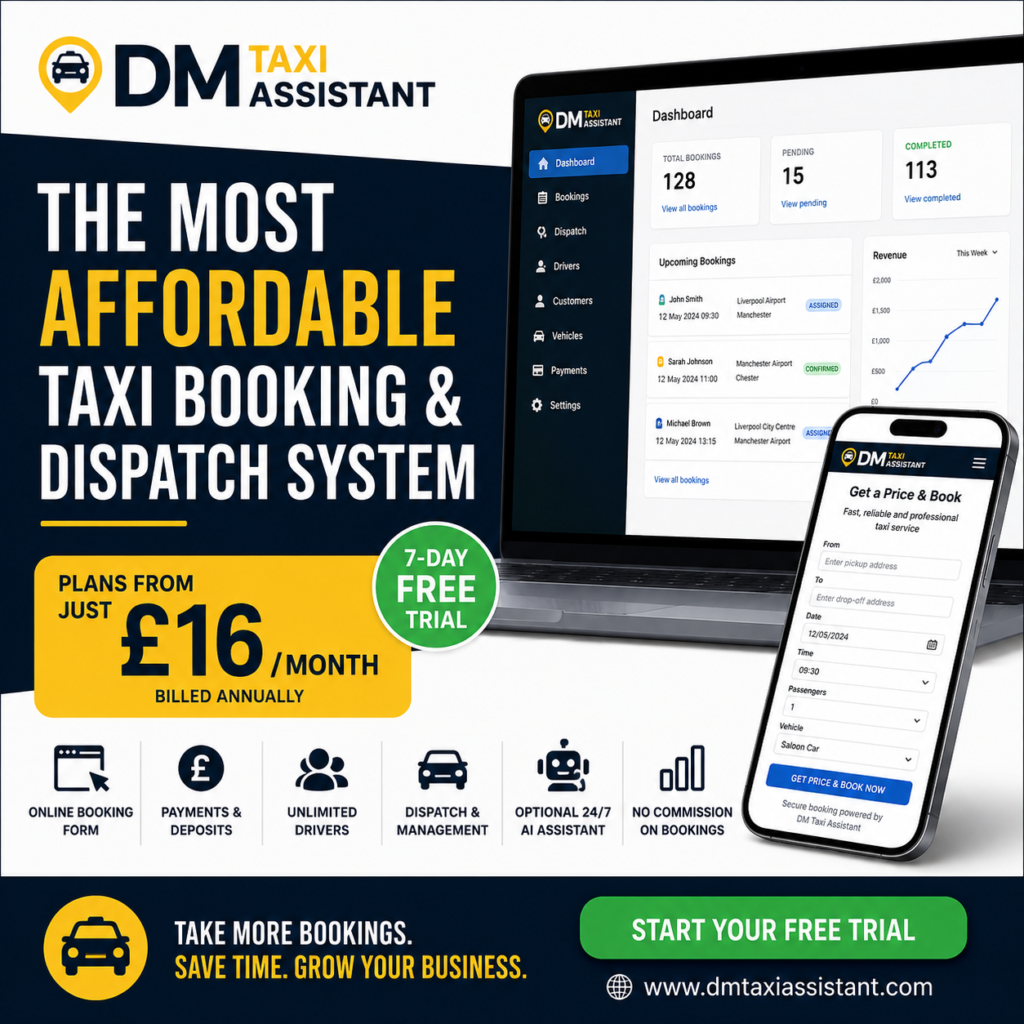
DM Taxi Assistant is designed specifically for taxi, private hire, chauffeur and airport-transfer businesses and can help operators manage customer enquiries, quotes, bookings and driver-dispatch workflows.
It is particularly useful for drivers making the transition from simply completing work for somebody else to building their own direct-booking business.
Software does not replace the need for the correct operator, driver, vehicle or insurance licences. Think of it as the system that helps run the business once the legal foundations are in place.
Do I need a website?
If you only intend to work through another operator or an app, you do not need your own business website just to hold a private hire driver licence.
But if your goal is eventually to obtain your own customers, having a website can become one of your most important assets.
A good taxi or private hire website can target searches for:
- taxis in your town
- airport transfers
- long-distance transfers
- executive travel
- business travel
- specific airport routes
- event transport
It also gives repeat customers somewhere to book directly rather than searching for another company every time they need transport.
If you are starting from scratch and do not have a website, DM Site Builder offers a free website option for taxi, private hire, chauffeur and other businesses, giving new operators a way to establish an online presence without paying a web designer before they have generated their first bookings.
DM Taxi Assistant can then provide the booking and operational side of the business.
Together, the idea is simple: create somewhere customers can find you, then give them an easy way to enquire, book and return.
Do private hire drivers have to register for tax?
Driving professionally creates tax responsibilities.
First-time licence applicants may be required to confirm that they understand HMRC’s tax guidance.
The separate HMRC tax-check requirement commonly applies when renewing a relevant licence or applying for the same type of licence with another licensing authority.
Where a tax check is required, HMRC issues a code which is supplied to the licensing authority.
How you actually pay tax will depend on the way you work.
You could potentially be:
- self-employed
- an employee
- operating through a company
- working under another business structure
If you are unsure, speak to an accountant or check the latest HMRC guidance.
Do not assume that an app or private hire operator automatically deals with all of your tax obligations.
Can you become an Uber driver after getting a private hire licence?
A private hire driver licence is one part of becoming an Uber driver.
You will also need to satisfy the licensing requirements for the vehicle you drive and meet Uber’s current onboarding requirements in the area in which you want to work.
Being accepted by Uber does not replace your legal licensing obligations.
The same principle applies to other ride-hailing platforms.
Can you become a private hire driver without owning a car?
Yes.
Some drivers rent licensed private hire vehicles or work with fleets rather than buying their own vehicle.
This can reduce the initial cost of purchasing a car, although weekly rental costs can significantly affect profit.
Before renting, check:
- what is included
- insurance arrangements
- mileage restrictions
- maintenance responsibility
- excess charges
- licensing authority
- whether you can use the vehicle with your chosen operator
Work out the full weekly cost before signing a rental agreement.
Is becoming a private hire driver worth it?
That depends heavily on your circumstances.
Private hire can offer flexible working and an accessible route into professional driving, but the business has substantial running costs.
Before committing, estimate:
Expected weekly revenue
minus:
insurance + vehicle + fuel/charging + maintenance + licensing + operator/app charges + tax + other costs
That gives you a much better picture than simply looking at gross driver earnings.
The drivers who eventually build a larger business often move beyond relying exclusively on app work and begin developing their own repeat customers, airport-transfer work and direct bookings.
That requires more responsibility and, usually, an operator licence — but it is also the point at which a driver begins building an asset of their own.
Private hire driver checklist
Before starting your application:
- Choose your licensing authority
- Read its current private hire driver policy
- Check age and driving-licence requirements
- Check your right-to-work documentation
- Arrange the required DBS or criminal-record checks
- Check medical requirements before booking an examination
- Complete required training and assessments
- Submit the driver licence application
- Check vehicle licensing rules before purchasing a car
- Obtain suitable hire-and-reward insurance
- Join a licensed private hire operator
- Understand your tax responsibilities
- Keep records of licence and renewal dates
And if your longer-term goal is to build your own taxi or private hire company:
- Research private hire operator licensing
- Choose a business name
- Build a website
- Set up a booking system
- Develop your pricing
- Start collecting genuine customer reviews
- Build repeat and direct bookings
What should you read next?
Getting your private hire driver licence is only the beginning.
The next stage depends on what you want from the industry.
If you simply want flexible driving work, joining an existing licensed operator may be enough.
If you want to build your own customer base, employ or dispatch other drivers, take airport bookings and create a business that is not dependent entirely on an app, the next guide you should read is:
How to Become a Private Hire Operator in the UK
That guide will cover operator licensing, accepting bookings legally, business setup, websites, booking software, drivers, record keeping and the practical steps involved in turning private hire driving into your own business.
Thanks for visiting DM News! If you’ve got a question, a story tip, or anything you’d like to share, head over to DriverMatty.com� — I love to hear from you. While you’re there, don’t forget to check out my other websites and social media channels.
Sources
Driver licences for taxis and private hire vehicles — GOV.UK
Operator licences for private hire vehicles — GOV.UK
Vehicle licences for taxis or private hire vehicles — GOV.UK
Statutory Taxi and Private Hire Vehicle Standards — Department for Transport
Complete a tax check for a taxi or private hire licence — HMRC
Private hire driver licence requirements — Transport for London
Taxi and private hire car licensing guidance — Scottish Government
Apply for or renew a taxi driver licence — Northern Ireland Direct
English Devolution and Community Empowerment Act 2026 — legislation.gov.uk




