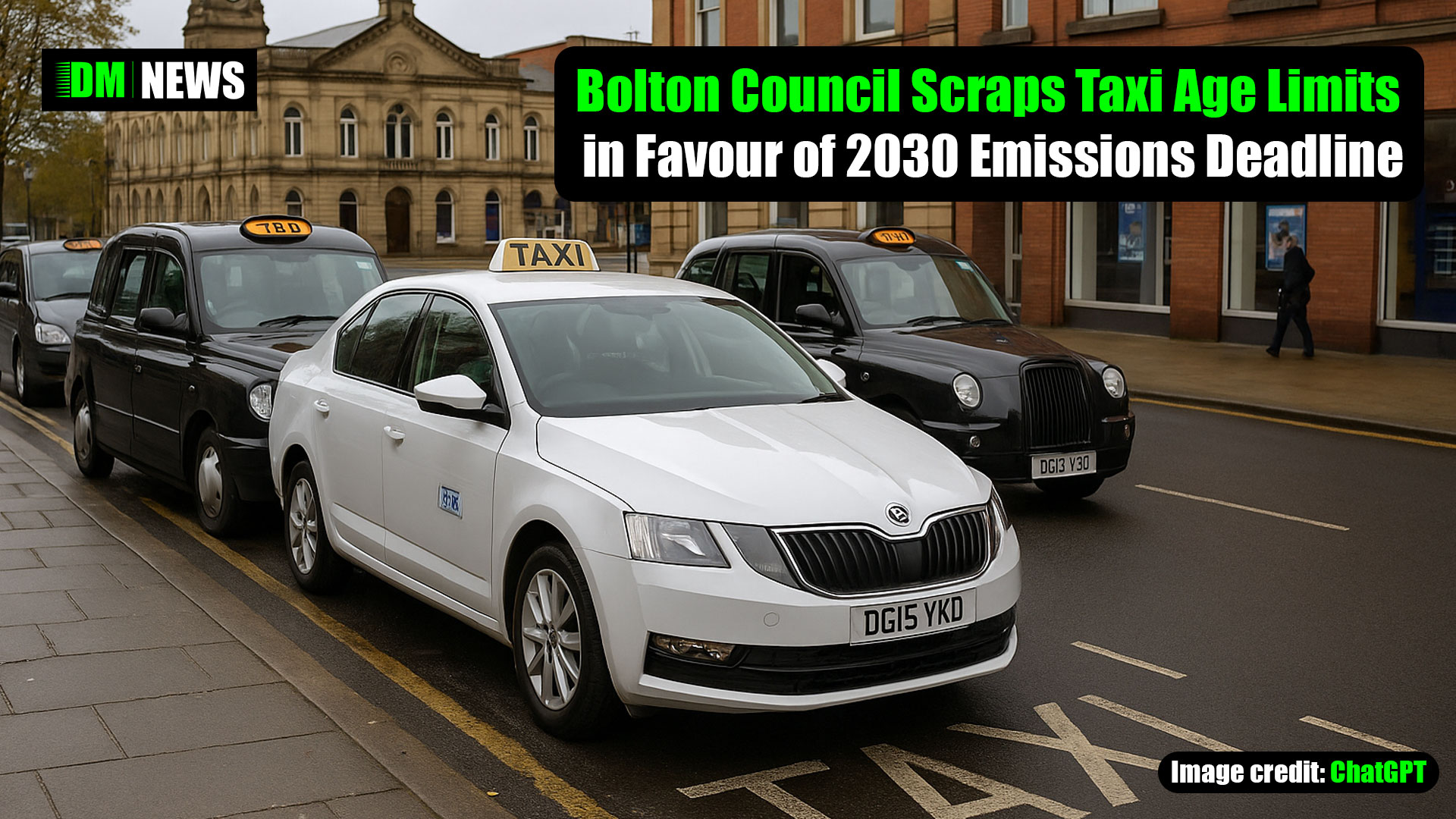
Bolton Council has voted to remove age restrictions on hackney carriages and private hire vehicles, instead requiring all licensed taxis to meet strict emissions standards by 31 August 2030.
The move brings the borough in line with the Greater Manchester Clean Air Plan and new Department for Transport guidance, which advises councils against setting “arbitrary age caps” on vehicles.
From Age Caps to Emissions Standards
Since 2004, Bolton rules meant hackney carriages could not be licensed if they were more than 10 years old at first grant or more than 15 years at renewal. That policy will now be scrapped.
Council officials argued that well-maintained older vehicles can often be cleaner than newer petrol or diesel models, particularly when fitted with emissions-reducing technology. Safety will still be enforced through twice-yearly MOTs and compliance tests.
Licensing manager Patricia Clyne told councillors the change was essential:
“If we remove the hackney carriage age policy, we have a number of open applications where people just haven’t been able to afford or find a vehicle. Removing this barrier could encourage new drivers to join the fleet.”

Deadline Extended After Funding Delays
The new 2030 deadline replaces a much earlier cut-off date of December 2025, which many drivers were struggling to meet. The extension follows delays in government funding and negotiations between Greater Manchester councils and ministers.
Figures show that 54 hackney carriages and 319 private hire vehicles in Bolton currently fail to meet Euro 6 diesel or Euro 4 petrol emissions standards.
To support the transition, the government has set aside £8 million in Clean Taxi Fund grants for hackney carriages across Greater Manchester, offered on a tiered basis:
- £12,560 for a zero-emission wheelchair-accessible cab
- £6,280 for an emissions-compliant petrol/diesel WAV
- £7,530 for a new or second-hand zero-emission non-WAV
- £3,770 for an emissions-compliant petrol/diesel non-WAV
- £6,280 for an emissions-compliant 6+ seat non-WAV
However, no equivalent funding has yet been confirmed for private hire drivers, sparking frustration across the trade.
Declining Hackney Numbers Raise Concern
Labour councillor Donaghy expressed concern that hackney carriage numbers have “dropped to nearly half” of pre-Covid levels, warning this could affect vital services.
“Hackney carriages are particularly useful for children’s services and for elderly passengers. I am worried that this could have an impact on the council,” he said.
Clyne also highlighted the financial challenges facing drivers, noting that the high cost of purpose-built hackney vehicles and competition from app-based services had hit the trade hard.
Still, she hopes the rule change could encourage new entrants:
“It is hoped this might encourage those with open licence applications to now go and find a vehicle. In the longer term, the hackney industry is suffering significant decline, but this is one way we can support it.”
Regional Impact
Greater Manchester leaders say aligning borough policies on vehicle licensing is crucial to prevent “licence shopping” between councils, where drivers seek out the least restrictive rules.
Bolton’s decision now puts it in step with the wider city-region strategy, giving drivers more time to upgrade while ensuring the long-term goal of cleaner air across Greater Manchester.
Sources:
Thanks for visiting DM News! If you’ve got a question, story, or anything you’d like to say, head over to DriverMatty.com — I’d love to hear from you! And while you’re there, don’t forget to check out my other websites and social media channels.